 heala
healaFive Recovery Day Workouts Under 40 Minutes With Wearable Cues
Five Recovery Day Workouts Under 40 Minutes With Wearable Cues
On recovery days, choose very low‑intensity movement — walking, gentle yoga, mobility drills or easy cycling and swimming — done at a talk‑test intensity for between a short and moderate duration. Do this well and you should come out of a recovery day feeling looser and more refreshed, not fatigued and not itching for a nap.
TL;DR:
Active recovery should involve 20 to 40 minutes of talk-test effort movement, such as walking, gentle yoga, or swimming, done on rest days.
Light movement helps reduce soreness, stiffness, and supports sleep and consistency, but should stay relaxing and avoid feeling performance-driven.
Use heart rate and wearable data trends, such as HRV and sleep quality, to personalize recovery intensity, rather than sticking to fixed routines.
Avoid active recovery when experiencing injury, sharp pain, or if advised by a doctor, and prioritize passive rest under these conditions.
Consistency and listening to your body’s signals matter more than variety or complex routines when planning recovery days.
Table of Contents
What is active recovery, and why does it help?
Active recovery means light, purposeful movement on the days between hard training sessions, rather than sitting still. Passive rest, by contrast, is doing nothing at all. Both have their place, but active recovery tends to do more for how you feel the next day.
The physiology is straightforward. Gentle movement increases blood flow to worked muscles, which helps clear metabolic waste and deliver nutrients faster than lying on the sofa ever could, according to Medical News Today’s overview of active recovery. NASM frames active recovery as useful in three distinct contexts, and picking the right one matters:
-
Between sets, to keep blood moving during a session.
-
Immediately after training, as a cool‑down.
-
Between training days, which is what most people mean by a recovery day, according to NASM’s guide to active versus passive recovery.
Passive rest remains appropriate after an acute injury, a sharp pain flare, or when a doctor has advised to avoid using a joint. Active recovery is suitable for general tiredness, not injury.
What are the real benefits of recovery day workouts?
The main payoff is a reduction in how sore you feel, not necessarily how damaged the muscle is. Delayed onset muscle soreness (DOMS) responds well to light movement and to self‑myofascial release, and foam rolling in particular has been shown to reduce perceived soreness while temporarily improving range of motion, according to a systematic review of foam rolling research.
Beyond soreness, recovery day workouts:
-
Keep joints moving through their full range, which reduces next‑day stiffness.
-
Support better sleep quality by keeping your body clock and activity rhythm consistent.
-
Preserve the habit of training daily, which matters more for long‑term consistency than any single hard session.
-
Leave you mentally readier for the next demanding workout instead of dreading it.
Statistic Callout: Research recommends spending a few minutes of active recovery straight after an intense session as an effective cool‑down, according to research summarised on PubMed. That’s a useful minimum if you’re short on time and only manage a brief walk or stretch that day.
Five recovery day workout routines you can follow today
Each of these fits inside 40 minutes and asks for nothing more than a talk‑test check: if you can hold a full conversation, your intensity is right.
-
20 to 40 minute walk. Start at a strolling pace for a few minutes, then settle into a brisk but comfortable stride. Finish with some easy mobility work for your hips and calves. Walking on rest days has been shown to reduce soreness more effectively than staying inactive, according to Lift Strong’s active recovery guidance. Modification: swap flat ground for a treadmill at 0% incline if your legs are heavily fatigued.
-
20 to 30 minute gentle yoga flow. Move through cat‑cow, downward dog, low lunge, pigeon and a supported twist, holding each for five to eight slow breaths. Keep breathing longer than the stretch feels comfortable. Modification: use a chair for balance poses if your legs are wobbly.
-
20 to 30 minute low‑impact cardio. Cycling, an elliptical, or swimming all work. Warm up for five minutes at an easy effort, hold a steady conversational pace for the middle stretch, then cool down for five minutes. Modification: if your knees are sore, swap the bike for the pool.
-
10 to 15 minute mobility circuit. Run through ankle circles, hip openers, thoracic rotations, shoulder pass‑throughs, walking lunges with a twist, and a deep squat hold, spending around a minute on each. Short routines like this, moving joints through full range, can reduce stiffness and improve readiness for your next session, according to an Outside Online active recovery routine. Modification: break it into two five‑minute “movement snacks” spread across the day if a single block doesn’t suit your schedule.
-
5 to 10 minute foam rolling plus light activation. Roll quads, calves, glutes and upper back for 30 to 60 seconds each, then finish with two sets of ten glute bridges or light band walks. Modification: if a spot is genuinely painful rather than tight, skip rolling it and move to the next muscle.
Pro Tip: If a routine starts to feel like a workout, you’ve overshot it. Active recovery should feel relaxing and productive, not performance‑driven — dial the effort back rather than pushing through.
How do you pick the right intensity and schedule?

The talk test is the simplest gauge: if a full sentence leaves you breathless, ease off. In heart‑rate terms, that usually lands around 30 to 60% of your maximum, well below anything you’d call training, according to NASM.
Two templates cover most training weeks:
-
Beginner or general fitness: 3 hard sessions, 2 active recovery days, 2 full rest days.
-
Intermediate to advanced: 4 hard sessions, 3 recovery days alternating between active movement and passive rest depending on how you feel.
Daily readiness varies more than most people expect, so treat these templates as a starting point, not a rulebook. Signs you’ve made a recovery day too hard include waking up more sore the next morning, a resting heart rate that’s still elevated, or genuinely dreading the next session. If any of those show up, drop the following week’s recovery day to a slower pace or a shorter duration.
When should you avoid active recovery?
Active recovery isn’t the right call every time you feel tired. Skip it and choose full passive rest when you have an acute injury, sharp or localised pain, a fever, or explicit medical advice to stay off a limb.
Older adults, complete beginners, or anyone recovering from illness should treat the talk‑test intensity as an upper limit, not a target, and lean towards the gentler end of every routine above.
A short day‑of checklist keeps recovery days from backfiring:
-
Hydrate properly; dehydration mimics fatigue and muddies how you judge intensity.
-
Get adequate protein to support the muscle repair already underway.
-
Prioritise sleep, since that’s when most actual recovery happens; integrating gentle movement into your morning can also help, as recommended in morning routines for better rest.
-
Avoid heavy lifting sessions or intense classes, no matter how good you feel.
How can wearable data sharpen your recovery decisions?
Guesswork gets you close, but heart rate variability (HRV) and sleep trends get you closer. Consistently high HRV and solid sleep tend to favour active recovery at the low end of the intensity range, while a rough night or a dip in HRV is a reasonable signal to default to passive rest instead, based on how Heala’s platform interprets these metrics.
For more on the balance between training stress and rest, overtraining is rarer than under‑recovering, and muscle tissue has its own recovery timeline worth understanding before you plan a week.
Heala’s capabilities that support this kind of decision include:
-
Integration with Fitbit and WHOOP for HRV and sleep data.
-
Adaptive daily plans that shift based on real‑time readiness.
-
Centralised tracking across training, nutrition and recovery, so patterns are easier to spot.
Why most recovery day advice misses the point
Most recovery advice treats every rest day the same, as though a fixed 30 minute walk works identically for everyone regardless of how their body is actually doing that morning. That’s the gap worth closing. The talk test and the 30 to 60% heart‑rate band are genuinely useful defaults, but they’re a floor, not a formula, and the biggest mistake is applying yesterday’s plan to today’s body.
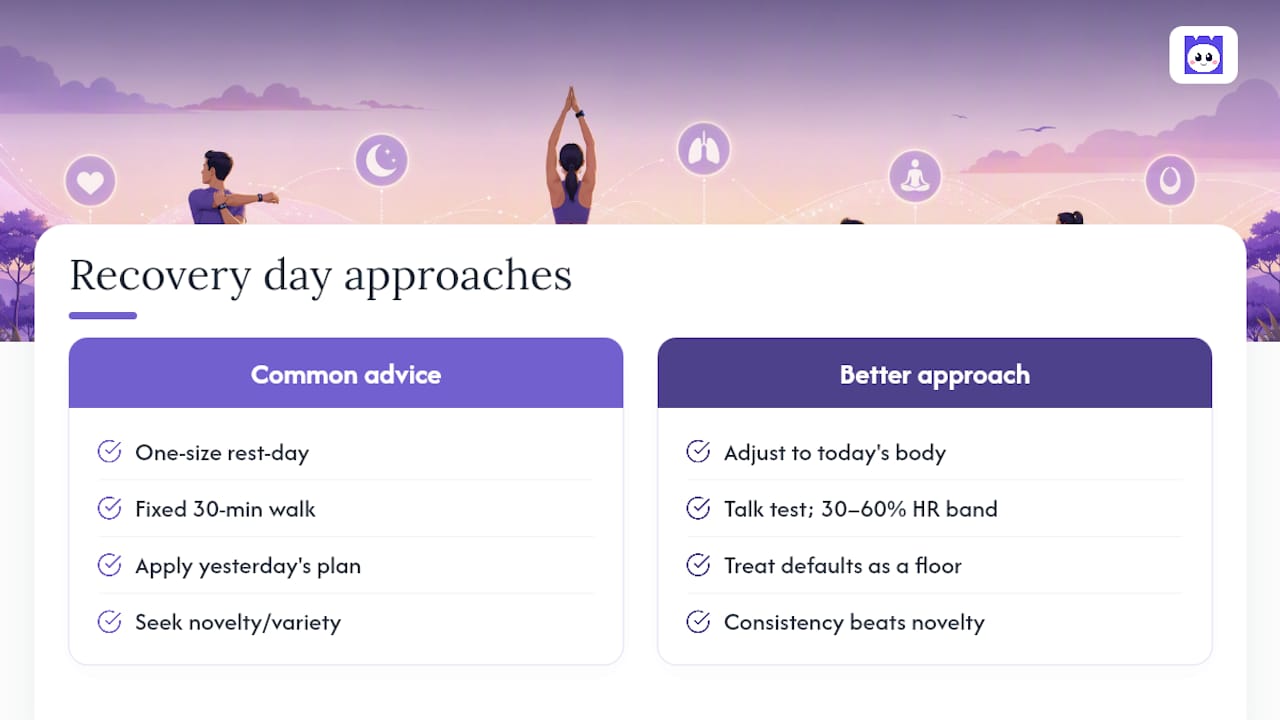
What’s overrated is the idea that recovery days need variety or novelty to be effective. A walk done consistently beats a different fancy mobility flow every single day. What’s underused is paying attention to your own signals, whether that’s a rough sleep, a nagging tightness, or simply not fancying it. Data from a wearable can sharpen that judgement, but it doesn’t replace it.
If you take one thing from this guide, prioritise consistency of effort over cleverness of programming. Show up, keep it easy, and let the recovery day actually be one.
— Kerem
Let Heala plan your recovery days for you
Recovery day workouts work best when they’re matched to how your body is actually doing, not a generic template. Heala pulls in your HRV, sleep quality and training load from wearables like Fitbit and WHOOP, then adapts your daily plan to suggest whether today calls for a brisk walk, a gentle yoga session, or genuine rest.
The app centralises everything, from sleep tracking to weight trends, so recovery decisions are based on your actual patterns rather than a fixed weekly rule. If you’re also managing training around a menstrual cycle, cycle‑aware recovery recommendations add another layer of personalisation most fitness apps skip entirely.
The app runs on a freemium model, offering a free tier and optional subscription with additional features. Try Heala and let your next recovery day be based on what your body is telling you, not a guess.
Sources
Recommended
Heala opens 2 October 2026
Free forever — Pro is optional.
Photo food logging, adaptive training, a morning recovery score and a 3D body twin, in one app.