 heala
healaBuild a Personalized Fitness Plan in One Hour That Adapts to Wearables
Build a Personalized Fitness Plan in One Hour That Adapts to Wearables
Build a personalised fitness plan by working through five steps in order: assess your starting point, set one measurable goal, design a weekly structure with progression built in, add nutrition and recovery targets, and track results so you can adapt. You can do this on paper in an hour, or let an adaptive app like Heala handle the adjustments using your wearable data.
TL;DR:
- Personalised fitness plans outperform generic routines by increasing adherence and delivering better results through tailored assessments and goal-setting.
- Assessing current strength, movement, equipment, and health status upfront prevents building plans that are too advanced or misaligned with resources.
- Progression should focus on increasing one variable at a time, such as load or reps, over four to eight weeks, to ensure sustainable improvement.
- Nutrition and recovery strategies, including adequate protein intake, sleep quality, and deload weeks, are critical to translating training efforts into results.
- Using adaptive apps that sync with wearables enables real-time adjustments based on recovery data, preventing fatigue and optimizing training effectiveness.
Table of Contents
- What is a personalized fitness plan, and why does it beat a generic one?
- How do you assess your starting point and resources?
- How do you set fitness goals that actually drive your plan?
- How do you build a weekly training plan with real progression?
- How much do nutrition and recovery matter to your results?
- How do you know when to adapt your plan?
- What features and templates actually matter for personalisation?
- What do people consistently get wrong when personalising their plan?
- Get a plan that adjusts itself around your data
- Sources
What is a personalized fitness plan, and why does it beat a generic one?
A personalised fitness plan is a training programme built around your current ability, available time, equipment, and specific goal, rather than a one-size-fits-all routine copied from a magazine or influencer feed. The distinction matters more than most people assume. Trials comparing individualised prescriptions with generic programmes consistently show better adherence and stronger outcomes when the plan reflects the person doing it, not an average of thousands of other people.
That’s the whole case for personalisation in one line: a plan you can actually stick to beats a theoretically perfect one you abandon in week three. Everything below is about how to build that plan, whether you write it yourself or lean on software to do the heavy lifting.
How do you assess your starting point and resources?
Before you write a single session, work out what you’re starting from. Skipping this step is the single biggest reason people copy a plan that’s wrong for them from day one, whether it’s too advanced, too time-hungry, or built around equipment they don’t have.
Run through a short baseline check:
- Strength markers: test a comfortable working weight for a squat, hinge, push and pull movement, not a maximum lift.
- Movement screen: note any pain, restricted range, or asymmetry, especially in shoulders, hips and the lower back.
- Equipment and time audit: list what you actually have access to and how many uninterrupted sessions you can commit to weekly.
- Health flags: get medical clearance first if you have a cardiovascular condition, a recent injury, or you’re returning after a long break.
- Wearable baseline: if you use a device, pull recent sleep, resting heart rate and activity load to see your current recovery capacity.
Movement-based exercise prescription reduces injury risk and improves functional outcomes compared with picking exercises off a template. Ten minutes of honest assessment now saves weeks of frustration later.
How do you set fitness goals that actually drive your plan?
Vague goals produce vague plans. “Lose weight” or “get fit” tells you nothing about how many sets to do or what to eat on a Tuesday. Convert the aim into a number and a deadline: “lose body fat in a few months” or “add 10kg to my deadlift by June” gives you something a weekly plan can actually be built around.
Where goals compete, pick one primary objective and treat the rest as secondary. Trying to maximise fat loss and strength gain simultaneously usually means doing both badly. A few working rules:
- Rank goals explicitly: one primary, one supporting goal, and drop the rest for now.
- Expect early wins to be mostly neurological, not muscular. Novices see measurable strength gains within a few weeks, often before visible physique change.
- Set a checkpoint at four weeks, not twelve, so you catch a mismatched plan early rather than late.
How do you build a weekly training plan with real progression?
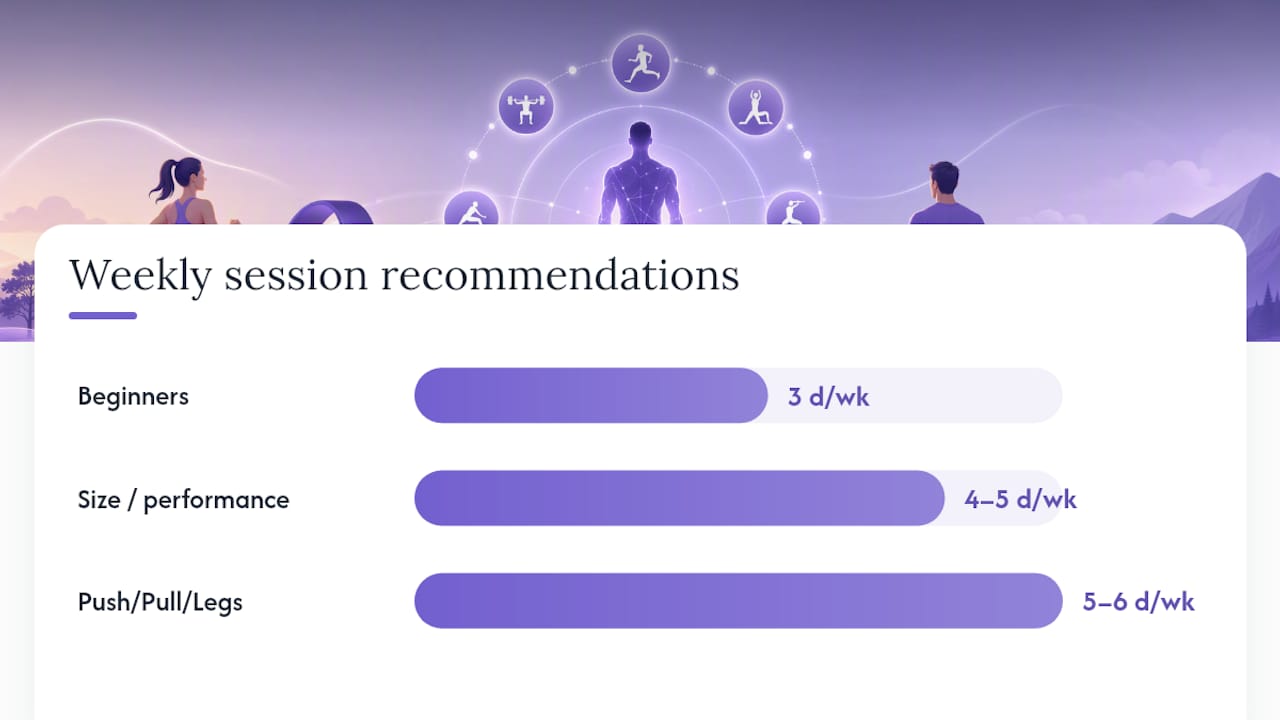
The structure you choose depends on time and goal, not fashion. Three sessions a week suits most beginners; four to five suits people training for size or performance with more recovery capacity. Full-body sessions work well under three days weekly; an upper/lower split fits four days; push/pull/legs needs five or six to make sense.
A simple beginner template, three days weekly:
- Day 1, full body: squat pattern, horizontal push, horizontal pull, core work. Around 45 minutes.
- Day 2, full body: hinge pattern, vertical push, vertical pull, light conditioning. Around 45 minutes.
- Day 3, full body: repeat day one’s patterns with different exercises, then 15 to 20 minutes of steady cardio.
An intermediate template, four days weekly, splits upper and lower body, with day one and three focused on heavier compound lifts and days two and four on accessory volume and conditioning.
Every session follows the same shape: five to ten minutes warming up, main compound lifts first while you’re fresh, accessory work second, conditioning last if programmed. Progress across a four to eight week block by adding load, reps, or a session, never all three at once. Progression can come from volume, intensity or frequency, and rotating which one you push keeps you improving without burning out on a single variable. Heala’s breakdown of progressive overload’s five dials covers this in more depth if you want the mechanics.
Pro Tip: Increase only one variable at a time. Add weight or add a rep, not both in the same week. It’s slower on paper but far easier to sustain over months.
How much do nutrition and recovery matter to your results?
Training drives adaptation, but nutrition and recovery decide whether your body can actually use it. Get the basics right before worrying about anything more advanced.
For most goals, protein around 1.6 to 2.2g per kilogram of bodyweight daily supports muscle repair, while calorie intake should trend down slightly for fat loss or up slightly for muscle gain, adjusted every few weeks based on results rather than guessed upfront.
- Keep a consistent sleep window; poor sleep is linked to reduced performance and higher injury risk.
- Build one deload week into every four to eight week training block, dropping volume by roughly a third.
- Spread protein across meals rather than loading it into one sitting.
- Set a simple hydration target and treat it as non-negotiable, not optional.
Small, boring habits, hit consistently, outperform occasional heroic efforts most people never repeat.
How do you know when to adapt your plan?
Track four things weekly: adherence (did you complete the planned sessions), load progression (are the numbers moving), a simple performance marker (a rep max or a conditioning time), and recovery signals like sleep and resting heart rate if you track them.
The decision rule is straightforward: give a plan four to six weeks before judging it, change one variable when you do adjust, and log the outcome so you know what actually caused the shift.
- If adherence drops below roughly 80%, the plan is too demanding for your life, not that you lack discipline.
- If load hasn’t moved in three consecutive sessions, drop volume slightly before dropping intensity.
- If resting heart rate trends upward alongside falling sleep quality, that’s usually under-recovery showing up before performance does.
Readiness metrics like HRV and sleep can flag fatigue before it shows up as a missed lift or a skipped session, which is precisely the gap adaptive apps are built to close. Heala’s piece on why under-recovery is so common walks through the pattern in more detail.
What features and templates actually matter for personalisation?
Not every fitness app or coaching service earns the word “personalised.” Before committing to one, check it against a short feature list: does it sync with your wearable, adjust your daily plan based on recovery data rather than a fixed calendar, let you log meals without painstaking manual entry, and surface readiness metrics you can actually act on.
- Wearable sync (Fitbit, WHOOP, Oura, Apple Health) so training reflects real recovery, not guesswork.
- Adaptive daily planning that shifts volume when sleep or HRV drops.
- Photo-based meal logging instead of manual food diaries.
- Recovery and readiness scoring you can check before you train.
Two starter templates worth copying: the three-day full-body beginner plan above, and the four-day upper/lower intermediate split. Adjust either by adding 5% load weekly if reps stay consistent, or a session if your calendar allows.
Apps can pull sleep quality, heart rate variability and recent training load from connected wearables and adjust the day’s plan accordingly, easing volume back on poorly recovered days and pushing it when the data shows you’re ready. If you’re weighing an app against a human coach, Heala’s comparison of an app versus a personal trainer sets out the trade-offs plainly.
| What matters | Why it matters |
|---|---|
| Wearable sync | Training reflects actual recovery, not a fixed weekly template |
| Adaptive daily planning | Volume shifts automatically when sleep or HRV drops |
| Photo meal logging | Removes the friction that kills nutrition tracking |
| Readiness scoring | Flags under-recovery before it shows up as a stalled lift |
What do people consistently get wrong when personalising their plan?
Start with the two mistakes I see most often. First, people change too many variables at once, then can’t tell whether the new exercise, the extra session, or the calorie cut caused the result. Second, they ignore the deload entirely and wonder why week six feels worse than week two.
Three things to do this week: run the baseline assessment properly rather than skimming it, write down one measurable goal with a date attached, and pick a four-week checkpoint before you start rather than deciding mid-plan that something isn’t working. Consistency beats intensity every time I’ve seen someone actually follow through on a plan long enough to judge it fairly.
— Kerem
Get a plan that adjusts itself around your data
The steps above work whether you build your plan on paper or hand the adjustments to software. Heala is built for the second route: it connects to your Fitbit, WHOOP, Oura or Apple Health data and reshapes your daily plan around actual sleep quality, heart rate variability and training load, rather than a fixed calendar you have to override manually every time life gets in the way.
If you’re training around a menstrual cycle, some apps offer cycle tracking alongside your training data so intensity can adjust with your phase rather than against it. Busy professionals and anyone juggling inconsistent schedules tend to get the most out of adaptive plans that bend around missed sleep or a heavy week rather than demanding you follow a script that no longer fits. Meal photo logging removes the manual entry that usually reduces adherence to nutrition tracking.
Start with the free tier at Heala and connect a wearable if you have one. The plan adapts from day one.
Sources
- PubMed record 19204579
- NCBI PMC article on progressive overload (PMC4562558)
- NCBI PMC article linking sleep and recovery (PMC7927075)
- NCBI PMC on individualised exercise prescription (PMC6303131)
Recommended
Heala opens 2 October 2026
Free forever — Pro is optional.
Photo food logging, adaptive training, a morning recovery score and a 3D body twin, in one app.