 heala
healaAthletes: HRV for Training With RHR, Wellbeing and a Seven Day Average

Athletes: HRV for Training With RHR, Wellbeing and a Seven Day Average
Used well, HRV for training is a genuinely useful daily readiness signal, not a fortune-telling device. The rule is simple: judge your rolling average against your own smallest worthwhile change, never a single morning reading, and treat resting heart rate and how you feel as equally important votes. Do that, and you’ll cut unnecessary hard days without losing fitness.
TL;DR:
- Use a validated device and avoid mixing measurement methods to ensure trend accuracy; reactions to alcohol, poor sleep, or stress can temporarily suppress HRV.
- Focus on rolling averages and the smallest worthwhile change to interpret HRV trends, rather than reacting to daily fluctuations or isolated low readings.
- Adjust training based on the seven-day HRV trend: maintain, reduce intensity, or substitute easy sessions when HRV drops beyond your SWC for multiple days.
- HRV is most effective when combined with sleep, resting heart rate, and subjective wellbeing data, forming a full recovery profile to guide training decisions.
Table of Contents
- What HRV is and why it matters for athletes
- How to measure HRV reliably: protocol and devices
- Interpreting HRV: baselines, rolling averages and the smallest worthwhile change
- Actionable rules: using HRV to modify daily training
- What trials and reviews actually say about HRV-guided training
- Common confounders and measurement pitfalls
- A practical daily and weekly workflow for HRV-guided training
- How we think about HRV alongside sleep and nutrition
- How Heala turns your HRV data into a daily plan
- Sources
What HRV is and why it matters for athletes
HRV, short for heart rate variability, measures the tiny fluctuations in time between consecutive heartbeats. Your heart doesn’t beat like a metronome. It speeds up and slows down constantly in response to breathing, hormones, and the tug of war between your sympathetic (“fight or flight”) and parasympathetic (“rest and digest”) nervous systems.
The metric athletes and researchers use most is RMSSD, the root-mean-square of successive differences between heartbeats. Higher RMSSD generally reflects stronger parasympathetic activity, which tends to track with better recovery and lower accumulated fatigue. A narrative review on HRV in strength and conditioning confirms RMSSD is the most practical time-domain metric for monitoring training status, precisely because it’s robust and easy to standardise across sessions.
The physiological logic runs like this: hard training, poor sleep, illness, and psychological stress all lean on your sympathetic nervous system. Your body needs parasympathetic recovery to repair and adapt. When that recovery lags behind the stress you’re piling on, HRV tends to suppress. Track that suppression over time and you get an early, individualised warning system for accumulated fatigue, long before performance actually drops.
Who benefits most from HRV for training?
- Endurance athletes managing weekly load across running, cycling, or triathlon, where fatigue builds silently across sessions.
- Strength and conditioning athletes trying to time peak efforts around genuine readiness rather than a fixed calendar.
- Anyone self-coaching, without a coach’s eye to spot early overreaching.
It’s worth being blunt about the limits here too. HRV is not a diagnostic tool. It won’t tell you if you’re getting a virus, and it won’t replace a coach’s judgement on technique or periodisation. Think of it as one voice in a small committee, not the sole decision maker.
How to measure HRV reliably: protocol and devices
Bad measurement protocol is the single biggest reason athletes lose faith in HRV for training. Numbers that jump around because you measured lying down one day and standing up the next are noise, not signal. Consistency is the entire game.
Here’s the standardised approach a practical measurement guide for athletes recommends, and one echoed across the strength and conditioning literature:
- Measure first thing in the morning, ideally within a few minutes of waking, before coffee, before checking your phone, before you’ve even had a proper conversation.
- Use the same posture every time. Supine (lying down) is the most common and most stable choice; seated works too, provided you never switch between the two.
- Record for at least one to five minutes. Ultra-short recordings under 60 seconds increase noise; most validated protocols use one to two minutes of clean data as a practical minimum.
- Collect seven to fourteen days before drawing conclusions. A single baseline reading tells you almost nothing. You need enough mornings to see your own natural range before you can spot a meaningful departure from it.
- Stick with one device. A validated chest strap reading R-R intervals directly, or a validated consumer wrist or finger sensor using photoplethysmography, can both work. What matters is that you don’t alternate between them.
That last point deserves emphasis. Measurement guidance from athlete-focused research is explicit that mixing chest-strap-derived readings with photoplethysmography from a different vendor introduces bias that quietly wrecks your trend line. You’re not comparing apples to apples, you’re comparing two different measurement philosophies and calling the mismatch “variability.”
The most common errors worth avoiding: measuring at inconsistent times (even an hour’s difference matters early in the morning), talking or moving during the recording, ignoring alcohol or a late meal the night before, and panicking over one bad number instead of waiting for the pattern to confirm itself.
Pro Tip: Set a recurring phone alarm labelled “HRV” for the exact same wake time each morning, even on rest days. The habit matters more than the exact minute, but sameness is what makes the data usable.
Interpreting HRV: baselines, rolling averages and the smallest worthwhile change
A single day’s HRV reading is close to useless on its own. Night-to-night variation from sleep position, room temperature, or a stressful email you read before bed can swing your number without any real change in recovery status. That’s exactly why smart HRV monitoring for athletes rests on rolling averages, not raw daily numbers.
The practical approach: take a seven-day rolling average of your morning RMSSD, updating it daily by dropping the oldest value and adding the newest. This smooths the noise and reveals whether your recovery capacity is trending up, holding steady, or sliding. Some athletes prefer a shorter three-day window for faster feedback, at the cost of slightly more noise.
Once you have that rolling average, you need a smallest worthwhile change (SWC) to decide when a shift actually means something. The SWC is typically calculated as a fraction of your personal day-to-day variation (commonly around 0.5 to 1 standard deviation of your baseline readings). In plain terms: if your seven-day average drops beyond that threshold, it’s a real signal worth acting on. If it wobbles inside that band, it’s just normal noise.
Practitioner guidance is consistent on this point: HRV is highly individual, and following your own trend line beats chasing an absolute number every time, whether yours sits at 40 milliseconds or 90.
Three things worth building into your interpretation habit:
- Never react to one bad morning; wait for the rolling average to actually cross your SWC boundary.
- Cross-check HRV against resting heart rate (RHR). A suppressed HRV alongside an elevated RHR is a much stronger fatigue signal than either alone.
- Recalibrate your baseline every few weeks, because genuine fitness gains shift your whole HRV range upward over time.
This is also where a rolling personal trend matters more than any single benchmark you’ll read online. Your 55ms might be someone else’s 85ms, and both can represent excellent recovery for that individual.
Actionable rules: using HRV to modify daily training
This is where the theory earns its keep. Vague advice to “listen to your body” isn’t a system. A system needs thresholds you can act on before you even open your training log.
Here’s a practical decision framework built around your seven-day rolling average and your SWC boundary:
- HRV at or above baseline (within your normal range): Train as planned. No adjustment needed.
- HRV drops beyond your SWC for one day: Proceed as planned, but flag it. One day rarely justifies a change.
- HRV drops beyond your SWC for two or more consecutive days: Reduce intensity first. Cut planned high-intensity intervals or max-effort work, but keep the session’s general shape.
- HRV stays suppressed for three or more days, with RHR also elevated: Substitute the session. Swap a hard interval day for 20 to 30 minutes of low-intensity aerobic work, or take a full rest day.
- HRV and RHR both recover to baseline: Resume normal programming, but don’t immediately double up on missed intensity. Ease back in over a session or two.
A randomised trial of HRV-guided high-intensity functional training put a version of this exact logic to the test. Athletes following HRV-guided adjustments completed significantly fewer high-intensity days than a group on predetermined programming, yet ended up with similar fitness and body composition improvements. Fewer punishing sessions, same outcome. That’s the entire value proposition of HRV-guided training in one study.
Concrete numbers help here. These aren’t rigid laws, they’re starting points to adjust as you learn your own response.
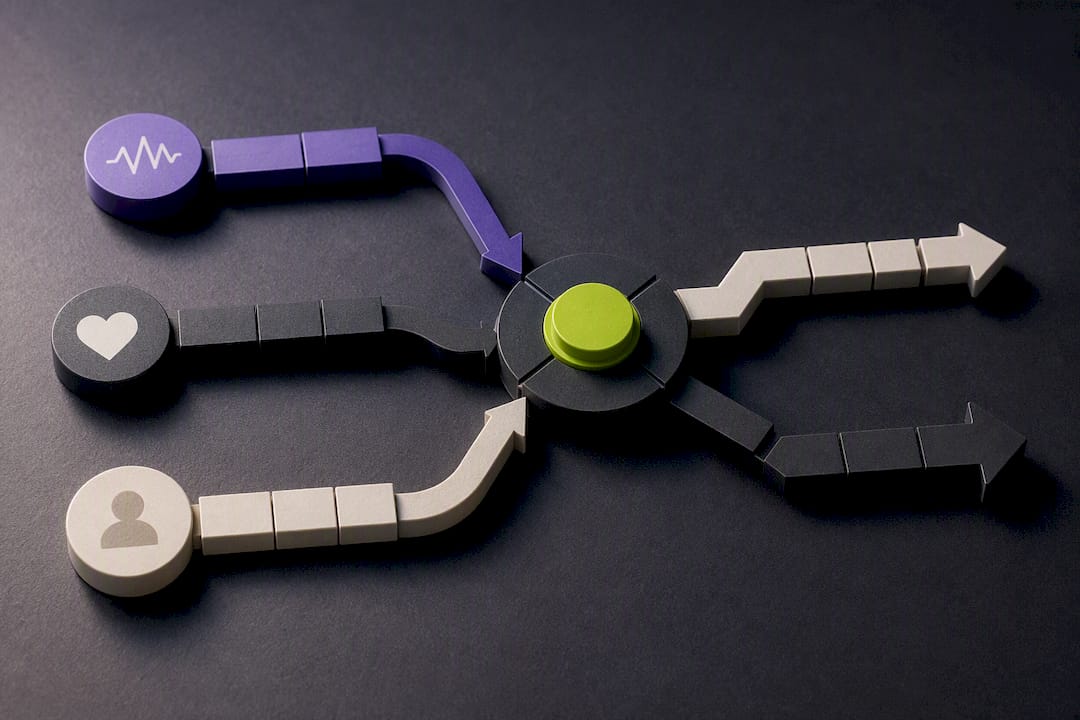
Don’t lean on HRV alone, though. The best evidence for this comes from a 2025 trial in experienced cyclists, where the group training according to vagal-mediated HRV, resting heart rate, and subjective wellbeing together saw markedly larger improvements than HRV alone would have predicted, with 20-minute power climbing from roughly 261W to 285W on average. Wellbeing logging alone is worth taking seriously too: research from the same trial found perceived stress often shows more day-to-day consistency than HRV itself, which makes it a genuinely useful tie-breaker on ambiguous mornings.
Build in exceptions deliberately. If a key competition or a specifically targeted training stimulus sits on the calendar, that session sometimes proceeds despite a suppressed reading, particularly if the suppression is mild and RHR hasn’t moved. This is where a coach’s judgement, or your own experience with your sport, should override a rigid rule.
Pro Tip: Write your personal decision rules down before you need them. Deciding “what counts as suppressed” in the calm of a Sunday planning session beats deciding it at 6am when you’re tired and looking for permission to skip a hard set.
What trials and reviews actually say about HRV-guided training
The honest evidence summary: HRV-guided training produces small, mostly favourable effects on vagal-mediated indices, and mixed, generally modest effects on group-level performance outcomes like VO2max. That’s not a dramatic headline, but it’s an honest one.
A systematic review and meta-analysis comparing HRV-guided training against predefined programming found consistent small advantages favouring HRV-guided approaches on measures like RMSSD, alongside performance effects that varied considerably between studies. Some trials showed clear benefit, others showed little difference at all.
The pattern across these reviews is less “HRV makes you fitter” and more “HRV helps you avoid training yourself into a hole.” The performance gains, where they exist, often come from what athletes were spared, namely excessive high-intensity exposure, rather than some direct physiological edge.
Why the inconsistency between studies? A few methodological factors explain most of it:
- Index choice varies. Some studies use RMSSD, others use different frequency-domain metrics, and these don’t always move in lockstep.
- Posture and timing differ across protocols. A study measuring seated readings isn’t directly comparable to one measuring supine.
- Averaging windows aren’t standardised. Three-day, seven-day, and rolling weekly windows all appear across the literature, each with different sensitivity to noise.
- Population and sport differ. Endurance cyclists, strength athletes, and recreational runners don’t respond identically to the same monitoring approach.
The two most instructive individual studies bookend this nicely. The HIFT trial showed HRV-guided athletes reaching similar fitness gains with markedly less high-intensity work, essentially proving the “personalised brake” theory of HRV in practice. The cyclist trial showed the opposite complementary point: HRV alone underperforms HRV combined with resting heart rate and subjective wellbeing. Read together, they suggest HRV’s real strength lies not in optimising performance on its own, but in preventing overreach while other metrics do some of the optimising.
Common confounders and measurement pitfalls
HRV reacts to far more than training load, and that’s the biggest trap for athletes new to using it. A single bad reading rarely means what you assume it means.
Alcohol is one of the most reliable HRV suppressors, often visible the following morning even after moderate drinking. Poor sleep, whether short duration or fragmented quality, does the same. Travel across time zones, incoming illness (sometimes days before symptoms appear), acute psychological stress, dehydration, and for many women, phases of the menstrual cycle, can all move your HRV independently of anything happening in the gym.
Watch for these common traps:
- Inconsistent measurement timing or posture, which manufactures false trends out of nothing.
- Overreacting to a single suppressed reading instead of waiting for the rolling average to confirm a genuine shift.
- Ignoring context entirely, treating every dip as training-related when the real cause was two glasses of wine or a delayed flight.
- Assuming higher HRV is always better. It isn’t. Elite athletes in heavy training blocks sometimes show naturally lower HRV that reflects appropriate adaptation to load, not a problem to fix.
That last point trips people up constantly. HRV is context-dependent, not a simple “bigger number wins” metric. A well-adapted endurance athlete deep into a structured block might sit lower than their off-season baseline and be performing exactly as intended. The number only means something read against your own history, never against someone else’s chart or a generic online benchmark. Chronic under-recovery is also a far more common problem than genuine overtraining, and HRV is often the earliest flag you’ll get for it.
A practical daily and weekly workflow for HRV-guided training
Turning all this into a habit is simpler than it sounds. It’s five minutes each morning, and one honest look at the week ahead each Sunday.
Morning checklist, in order:
- Take your HRV reading immediately on waking, same posture, same device, before coffee or your phone.
- Note your resting heart rate at the same time, ideally from the same device or session.
- Log a quick subjective wellbeing score, covering sleep quality, muscle soreness, and mood or motivation, even a rough one to ten scale works.
- Update your seven-day rolling average and check it against your SWC boundary.
- Apply the decision rule: train as planned, reduce intensity, or substitute a lower-intensity session.
A sample week shows how this redistributes effort rather than eliminating it. Say Monday and Thursday are planned high-intensity days. If your rolling average dips past SWC on Wednesday evening, Thursday’s interval session becomes 25 minutes of easy aerobic work instead, and the missed intensity shifts to Saturday, once your numbers recover. You still get your two hard sessions that week, just not on the calendar days you originally guessed.
Integration matters as much as the numbers themselves. If you work with a coach, share your rolling average trend rather than daily raw numbers. It’s a far more useful conversation starter than “my HRV was 52 this morning,” because it shows direction, not a snapshot. Pairing HRV-adjusted sessions with GPS-tracked cardio also helps you confirm that a substituted easy session actually stayed easy, rather than drifting back up into moderate intensity out of habit.
Pro Tip: Log your subjective wellbeing score before you look at your HRV number, not after. Seeing the HRV first quietly biases how you rate yourself, even when you’re trying not to let it.
How we think about HRV alongside sleep and nutrition
HRV earns its place in a training plan only when it sits next to other signals, not above them. On its own, a suppressed reading is a question, not an answer. Combined with sleep quality, resting heart rate, and how a session actually felt, it becomes something you can act on with real confidence.
That’s the thinking behind how Heala treats recovery data: HRV, sleep, and nutrition logged together, rather than three separate apps giving three disconnected verdicts. An athlete who sees suppressed HRV alongside three nights of short sleep gets a clear story. The same reading alongside perfect sleep and a big travel day tells a different one entirely.
Treat every threshold in this guide as a starting point, not gospel. Your baseline, your SWC, and your tolerance for a hard day when the numbers look shaky are yours to calibrate. For serious competitive planning, pair this with a coach who knows your history, not just your data.
— Kerem
How Heala turns your HRV data into a daily plan
Following the rolling average and SWC approach above by hand, in a notebook or three separate apps, is exactly the kind of friction that makes people abandon good habits within a fortnight. The app centralises HRV, resting heart rate, sleep, and wellbeing logging in one place, and builds your seven-day rolling average automatically so you’re never eyeballing noisy daily numbers.
The app pulls data straight from various wearables, then adjusts your daily plan based on where your trend actually sits relative to your own baseline, not a generic population average. Sleep gets tracked alongside HRV even without a dedicated sleep watch, and for athletes tracking cycle-related fluctuations, cycle tracking sits right next to your training log rather than in a separate app you forget to open. If you’re currently deciding between a dedicated strap and an integrated approach, it’s worth seeing how an app-based system compares to a standalone device for actually acting on the data day to day. Open the Heala app and connect your wearable to see your own rolling average build over your first week.
Sources
The evidence and protocols referenced throughout this guide come from peer-reviewed sources worth reading directly if you want the full methodology behind any of the rules above:
- Individual training prescribed by heart rate variability, heart rate and well-being scores in experienced cyclists | Scientific Reports
- Heart rate variability applications in strength and conditioning: A narrative review
This article is general information, not a substitute for advice from a qualified doctor. Consult a qualified healthcare professional about your own circumstances before acting on anything here.
Recommended
Heala opens 2 October 2026
Free forever — Pro is optional.
Photo food logging, adaptive training, a morning recovery score and a 3D body twin, in one app.