 heala
healaLog One to Three Habits in 10 Seconds, Habit Tracking for Health
Log One to Three Habits in 10 Seconds, Habit Tracking for Health
Track one to three keystone health habits every day, using whatever recording method takes the least effort, and review your progress once a week. This works because self‑monitoring makes progress visible, which keeps you motivated and gives you real evidence for adjusting your routine. Start today: pick one habit (a walk, a water target, a bedtime) and decide whether you’ll log it on your phone, in a notebook, or automatically through a wearable.
TL;DR:
- Focusing on one to three precisely defined habits reduces the risk of burnout and keeps tracking sustainable without causing anxiety.
- Habit tracking works by providing visual cues, reinforcing progress through reward loops, and offloading mental effort to the log itself.
- Automated data from wearables enhances trend analysis for sleep, weight, and activity, but should be combined with manual entries for habits requiring deliberate actions.
- Immediate recovery from missed days depends on avoiding two consecutive misses, which can shift your identity away from consistency and success.
- Using an integrated app that combines passive wearable data with manual habit logging minimizes friction and supports long-term adherence.
Table of Contents
- What does habit tracking for health actually do for you?
- Why does tracking actually change behaviour?
- How do you choose the right habit-tracking method?
- What healthy habits should you actually track?
- How do you start tracking and actually stick with it?
- How do wearables and integrated data improve habit tracking?
- What does realistic habit tracking actually look like?
- A consolidated option if you’d rather not juggle three apps
- Sources
- FAQ
What does habit tracking for health actually do for you?
Habit tracking for health works through three simple mechanisms, and once you see them, the appeal is obvious.
- It reminds you. A visible log acts as a cue, so you don’t rely on willpower or memory to start the habit.
- It motivates you. Watching a streak build, or a trend line climb, gives you a small hit of satisfaction that keeps you going.
- It informs you. Over weeks, a tracker becomes a decision tool. You can see whether your sleep habit is actually improving your energy, rather than guessing.
A meta-analysis of many studies found that people who monitored their behaviour regularly were more likely to hit their goals than those who didn’t, across a wide range of domains, from fitness to diet to study habits. That’s a strong signal that the act of recording something changes how consistently you do it.
There’s a catch. Tracking too many things, or checking your numbers obsessively, can tip into anxiety rather than motivation. If a tracker starts to feel like a scoreboard you’re losing, the fix isn’t more discipline. It’s fewer habits. Drop back to one to three that actually matter to you, and let the rest go for now.
Most people overcomplicate this at the start. They try to track eight habits in week one, burn out by day ten, and conclude that tracking “doesn’t work for them.” It isn’t the tracking that failed. It was the scope.
Why does tracking actually change behaviour?
Several things happen at once when you write down or log a health habit, and understanding them helps you use tracking on purpose rather than by accident.
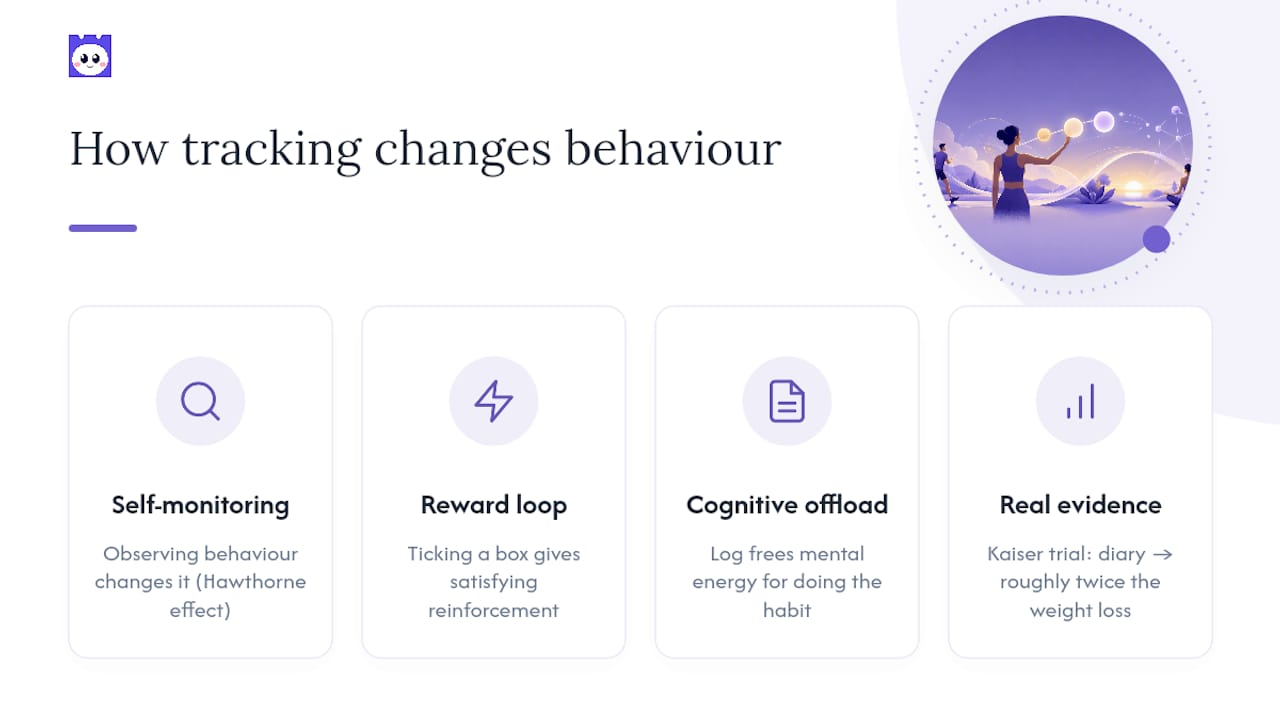
The first is self‑monitoring itself. Simply observing your own behaviour changes it, a version of the Hawthorne effect: people who know they’re being watched, even by themselves, tend to act differently. The second is a small dopamine reward loop. Ticking a box or watching a line move upward gives you a satisfying signal that reinforces repeating the action tomorrow. James Clear describes this well: trackers work because they provide immediate evidence of progress, a visual cue to act, and reinforcement that sustains behaviour. The third mechanism is cognitive offloading. Once a habit lives in a log instead of your head, you stop spending mental energy remembering whether you did it, which frees up attention for the harder work of actually doing it.
Habit tracking leverages reward loops and cognitive offloading in the brain. Missed days shouldn’t be read as failure. They’re data you can use to recalibrate the habit itself.
That framing, from Psychology Today’s primer on habit tracking, matters more than it sounds. Most people treat a broken streak as proof they’ve failed. Behavioural science treats it as a clue about design.
The clearest real‑world evidence sits in nutrition research. In a Kaiser Permanente trial, people who kept a daily food diary lost roughly twice as much weight as those who didn’t track at all, with everything else about their plan held constant. That’s not a small nudge. It’s one of the more striking examples of tracking alone changing an outcome, independent of any other intervention.
None of this means tracking is free of downsides. Logging every meal, every step, and every heartbeat can push some people towards fixation rather than progress. The goal is always the smallest amount of tracking that still gives you useful signal, tuned to what you personally respond to.
How do you choose the right habit-tracking method?
Before you download an app or buy a notebook, run through a short checklist. It’ll save you from switching methods three times in your first month, which is the single biggest reason people abandon tracking altogether.
- Friction. How many taps, or how much writing, does logging this habit require? If it takes more than ten seconds, you’ll skip it on a bad day.
- Automation. Can a wearable or app capture this passively (steps, sleep, heart rate variability), or does it need a manual entry every time?
- Habit type. Is this binary (did you meditate, yes or no) or quantitative (how many glasses of water)? Binary habits suit a simple checkbox; quantitative ones benefit from a number field or a graph.
- Privacy. Are you comfortable with health data, particularly anything cycle‑related or weight‑related, living on a company’s servers, or do you want it local and offline?
- Portability. Will you want to see this data next to other health metrics later, or is it a standalone habit you’ll never need to cross‑reference?
- Review cadence. Does this habit need a daily glance, or is a weekly summary enough?
Once you’ve answered those, the digital‑versus‑paper question mostly answers itself. Digital tools with wearable integration make sense when a habit is genuinely passive, like sleep duration or step count, where auto‑logging removes friction almost entirely. Paper, or a simple notes app, tends to win for habits that are more personal or reflective, such as a five‑minute meditation streak, where the physical act of ticking a box can matter more than the data itself.
There’s also good evidence that the medium itself matters less than people assume. What predicts success isn’t paper versus app. It’s whether you actually record something consistently, day after day.
Pro Tip: If you’re torn between two methods, pick whichever one you’d still be willing to use on your worst, most tired day. That’s the real test, not which one has the nicest interface.
Ask yourself three questions before committing: Do I already wear a fitness tracker I trust? Do I want one habit tracked in isolation, or several health metrics visible together? Am I the kind of person who’ll open an app, or the kind who’ll only glance at a sticky note on the fridge? Your honest answers matter more than any feature list.
What healthy habits should you actually track?
Vague goals produce vague results. “Move more” is not a trackable habit. “A 10‑minute walk before 10am” is. Precision is what makes tracking work, and it costs you nothing extra to define a habit properly the first time.
Here are habits worth tracking at different intervals, each defined tightly enough that there’s no ambiguity about whether you did it:
- Daily movement — a 10‑minute walk, logged as complete only once you’ve actually left the house.
- Hydration — an extra 500ml of water beyond whatever you already drink with meals.
- Sleep window — in bed with lights off within a consistent one‑hour window, aiming for seven or more hours.
- Medication or vitamins — taken at the same time each day, ideally stacked onto an existing routine like brushing your teeth.
- A short mindfulness practice — five minutes, timed, not “whenever I feel like it.”
- Two strength sessions per week — tracked as a weekly total rather than a daily tick, since strength training rarely fits a daily cadence.
- A weekly meal‑planning session — one sitting where you decide most of the week’s meals in advance.
- A monthly weigh‑in or body measurement — useful for spotting slow trends without the daily noise of water weight and digestion.
- A monthly recovery check — how sore, tired, or run‑down you’ve felt on average, rated simply on a one‑to‑five scale.
Notice that sleep, hydration, and movement all sit near the top. That’s not accidental. These are often called keystone habits, because improving one tends to pull the others along with it. Track your sleep window consistently for two weeks, and you’ll likely notice your energy for that 10‑minute walk improves without you doing anything else differently. That ripple effect is the real argument for starting with one habit rather than eight.
How do you start tracking and actually stick with it?
Getting started is less about motivation and more about designing the first week so it’s almost impossible to fail.
- Pick one to three habits and one medium. Choose habits you actually care about, write a one‑sentence success criterion for each (“walked outside for at least 10 minutes”), and decide now whether you’ll log them in an app, a notebook, or a wearable’s companion dashboard.
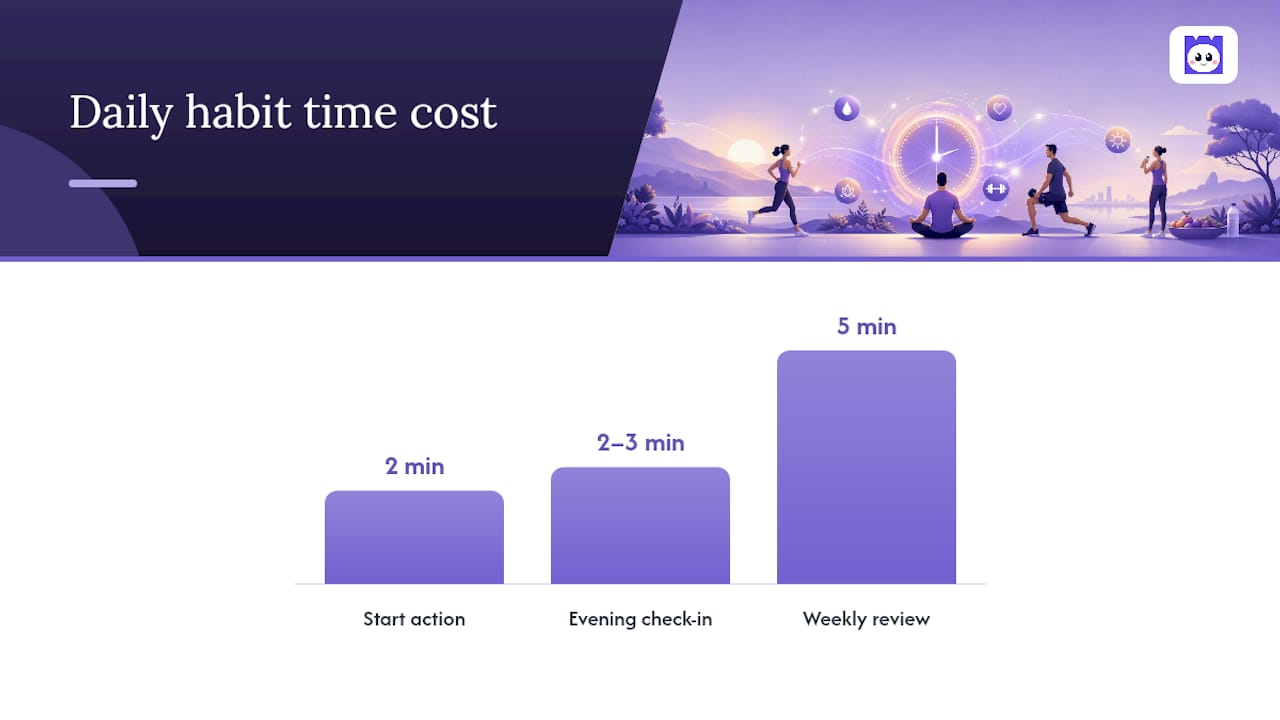
- Shrink the first step. Use the two‑minute rule: make the initial action so small it’s almost silly to skip. Don’t aim for a 30‑minute run in week one; aim for putting your shoes on and walking to the end of the street. Stack the habit onto something you already do without thinking, like logging your water glass the moment you make coffee.
- Check in daily, reflect weekly. Spend two or three minutes each evening marking what you did. Once a week, sit down for five minutes and ask what’s working, what’s slipping, and whether a habit needs redefining rather than abandoning.
Beneath those three steps sits one rule worth memorising: never miss twice. Missing one day is normal life; missing two in a row is where habits genuinely start to unravel. James Clear’s research on this is blunt about it: a single missed day rarely derails progress, but the second missed day changes your identity from “someone who does this” to “someone who used to do this.” Treat the second day as the line you don’t cross.
For habits that a wearable can capture passively, like sleep duration or resting heart rate, let automation handle the logging entirely. Save your manual effort for habits that genuinely need a human decision, like whether you actually did your stretching routine. Mixing automated and manual tracking this way keeps daily friction low without losing the habits that need a deliberate tick.
Pro Tip: If a habit breaks for more than three days running, don’t just restart it as-is. Spend two weeks jotting down why you missed each day. That short log usually reveals a design flaw, like a habit scheduled at the wrong time of day, that no amount of willpower would have fixed.
How do wearables and integrated data improve habit tracking?
Manual logging works, but it has a ceiling. You can write down that you slept “okay,” but you can’t manually sense your own heart rate variability or the exact minute you dropped into deep sleep. This is where auto‑logged data earns its place alongside the habits you track by hand.
- Sleep, HRV, steps, and weight trends reduce how much you have to remember to write down, and they surface patterns you’d never spot glancing at one night in isolation.
- Trend lines matter more than single data points. One bad night of sleep is noise; a two‑week decline is a signal worth acting on.
- Passive data works best paired with an active habit. A wearable can tell you your sleep dropped. It can’t tell you why, so pairing it with a manually tracked sleep‑hygiene habit, like a fixed screen cutoff time, gives you both the measurement and the lever to fix it.
This is roughly the gap Heala’s approach is built to close: it pulls in wearable data from devices like Fitbit and WHOOP alongside manually logged habits, so a dip in your sleep trend line sits next to the habit you’re actually trying to change, rather than in a separate app you have to cross‑reference yourself. Weight is a good example of where this matters, since a single weigh‑in means almost nothing on its own; it’s the trend across weeks that tells you whether a habit change is working.
Automatic, wearable‑sourced metrics reduce the manual reporting burden and surface long‑term trends that are genuinely useful for recalibrating a habit, rather than just adding another number to check.
The caveat is the same one that applies to any tracking: don’t let the dashboard replace judgment. A number going the wrong way for one day is rarely worth panicking over. It’s worth acting on only once it becomes a pattern.
What does realistic habit tracking actually look like?
Most guidance on this topic quietly assumes perfection is the goal, and that’s where it goes wrong. A broken streak isn’t a failure state. It’s information. Missing your walk on a Tuesday because you were sick tells you nothing bad about your character, and treating it that way is exactly what makes people quit tracking altogether by February.
The more useful mindset is to treat tracking as a design process you’re running on yourself, not a scoreboard someone else is judging. When a habit keeps slipping, the honest question isn’t “why am I so undisciplined?” It’s “what about this habit’s timing, difficulty, or definition is fighting against me?” Nine times out of ten, the fix is smaller and less dramatic than people expect: move the habit ten minutes earlier, cut the target in half, or stack it onto something more reliable.
— Kerem
A consolidated option if you’d rather not juggle three apps
If you’ve read this far and you’re already using a wearable, or you’re tired of moving numbers between three separate apps by hand, Some apps put wearable data and manual habit logging in the same place, so your trend lines and your daily ticks stop living in different apps.

That matters because the checklist earlier in this guide, friction, automation, habit type, portability, review cadence, is essentially a description of what an integrated app needs to get right. Certain health apps connect with popular wearables and services, capturing passive metrics such as sleep and heart rate variability automatically, while allowing meal logging by photo rather than manual entry.
- Automatic sync with a wearable can mean less manual logging, not more.
- Trend lines for weight and sleep sit next to the habits you’re actually trying to change.
- Cycle tracking runs alongside your training plan, rather than in a separate app you have to check independently.
If you want to see how it fits your own routine, the Heala app is worth a look before you commit to another standalone tracker.
Sources
The claims in this guide draw on a small set of sources worth reading directly if you want the fuller picture.
- Does Habit Tracking Actually Work? What the Science Says
- The ultimate habit tracker guide: why and how to track your habits
- Habit tracking: a primer
- PubMed entry for food diary weight loss study
FAQ
What is the 3‑3‑3 rule for habits?
There’s no single agreed definition of a “3‑3‑3 rule” in the behavioural research cited in this guide, so treat any version you see online with caution. The safer, evidence‑backed approach is the one used throughout this article: track one to three habits at a time, define each precisely, and review weekly.
What are the 7 healthy habits?
Lists like this vary by source, but the habits worth tracking that show up most consistently in research are: adequate sleep, regular movement, hydration, balanced nutrition, strength training, stress management, and consistent medication or vitamin use.
What are some healthy habits I can track?
Strong starting points include a daily 10‑minute walk, an extra 500ml of water, a consistent sleep window of seven‑plus hours, five minutes of meditation, and two weekly strength sessions, each defined precisely enough that “done” is unambiguous.
What are 10 healthy habits I can follow every day?
A workable daily set includes a short walk, hydration, a fixed sleep window, medication or vitamins taken on schedule, a few minutes of mindfulness, a protein‑forward breakfast, screen curfew before bed, a stretch or mobility break, sunlight exposure, and a two‑minute evening tracking check‑in.
Is a habit streak broken by one missed day?
No. A single missed day rarely derails progress, according to James Clear’s research; the practical rule is to never miss twice in a row, since that second miss is what tends to unravel a habit for good.
Does an app like Heala replace manual habit tracking?
Not entirely. Heala automates the metrics that benefit from automation, like sleep and heart rate variability, while still letting you log manual habits such as meditation or medication, giving you both without duplicating effort across separate apps.
Recommended
Heala opens 1 October 2026
Free forever — Pro is optional.
Photo food logging, adaptive training, a morning recovery score and a 3D body twin, in one app.