 heala
healaRecover Short Term Sleep Debt in About a Week Using Wearable Data
Recover Short Term Sleep Debt in About a Week Using Wearable Data
You can meaningfully reduce short-term sleep debt within about a week by protecting your sleep window and using short naps to take the edge off daytime sleepiness. Recovery isn’t a strict hour-for-hour repayment, though: your body prioritises deep sleep first. Chronic debt built up over weeks needs a longer, steadier plan, not one heroic weekend of catch-up sleep. Stop adding to the deficit, add modest extra sleep, and track how you actually feel.
TL;DR:
- Short-term sleep debt can be recovered within a week by fixing wake times, gradually shifting bedtime, and adding modest sleep opportunities.
- Larger or chronic deficits may take longer, with deep sleep increasing during recovery, and symptoms like mood and cognition normalizing at different rates.
- Naps should be limited to 15-20 minutes early in the afternoon and used as a bridge rather than a main repair tool; relying on weekend catch-up worsens social jet lag.
- Consistent habits such as waking at the same time daily, controlling light exposure, cooling the room, and cutting caffeine and alcohol after certain times are critical to prevent sleep debt recurrence.
- Tracking sleep duration, efficiency, heart rate variability, and weekly patterns, rather than single nights, helps accurately monitor recovery progress and identify persistent issues needing medical evaluation.
Table of Contents
- How to build a practical sleep debt recovery plan
- What does the research say about recovery speed?
- When do naps help, and when does sleep banking backfire?
- What habits stop sleep debt from coming back?
- How do you measure whether your sleep debt is actually improving?
- When does sleep debt point to something more serious?
- What actually keeps people stuck in sleep debt?
- Where Heala fits into your recovery plan
- Sources
How to build a practical sleep debt recovery plan
The instinct after a rough stretch is to sleep for twelve hours on Saturday and call it fixed. It doesn’t work that way, and chasing that fix is often what keeps people stuck. The better route is smaller, steadier, and starts tonight.
Here’s a sequence that works whether you’re recovering from one brutal week or a slow-motion deficit that’s been building for months.
- Fix your wake time first. Pick a wake time you can hit every day, weekends included, and don’t move it. This is the anchor everything else hangs off.
- Shift bedtime earlier in small steps. Move it 15 to 30 minutes earlier every 48 hours rather than trying to add three extra hours overnight. A board-certified sleep doctor’s one-week schedule built around exactly this pattern took one sleeper from six hours a night to seven within a week, tracked on an Oura ring.
- Add sleep opportunity, not sleep obligation. Aim for 30 to 90 extra minutes in bed rather than forcing yourself to lie there for ten hours. Extra time in bed without extra tiredness just produces frustration and lighter sleep.
- Use one tactical nap, not three. A single 15 to 20 minute nap in the early afternoon is worth more than dozing on and off through the day.
- Build a 30 minute wind-down. Dim the lights, put the phone down, and drop the bedroom temperature slightly. This is where most of the sleep-onset problems actually get solved.
- Hold your caffeine cut-off. Nothing caffeinated after early afternoon while you’re actively repaying debt, because caffeine sensitivity is often worse when you’re already short on sleep.
- Review after seven nights, not after one. One good night proves nothing. A week of data tells you whether the plan is working.
A sample week might look like this: nights one and two, bedtime 15 minutes earlier than usual with the same wake time; nights three and four, another 15 minutes earlier; nights five to seven, hold that new bedtime and add one afternoon nap on the two hardest days. Most people notice mood and concentration shifting by night four or five, though total recovery often takes longer than that.
Pro Tip: Write your wake time on a sticky note before you touch bedtime at all. Sleep debt recovery plans fail most often because people fixate on getting to bed earlier and let their wake time drift, which undoes the whole strategy.
The mistake worth avoiding here is treating this like a debt you can clear in one transaction. It behaves more like an under-recovery pattern that builds quietly until it’s loud, and it unwinds the same gradual way it built up.
What does the research say about recovery speed?
Recovery speed depends heavily on how the debt was built. A rough week has a different recovery curve to three months of six-hour nights, and treating them the same is where most advice goes wrong.
- Small, acute deficits (a night or two of lost sleep) tend to resolve within one to four nights of protected sleep.
- Larger acute deficits built across a hard week often need most of that following week to settle.
- Chronic debt, the kind accumulated over months of routinely shorting yourself, can require a week or more of consistent, protected sleep before it substantially reduces, according to sleep researchers at Rush University.
The mechanism behind this is genuinely interesting. Research on recovery sleep shows that during the first nights of catch-up, sleep becomes more intense, with a measurable increase in deep, slow-wave sleep. Your brain isn’t just adding hours; it’s front-loading the highest-value stage of sleep. That’s why you can feel dramatically sharper after two recovered nights despite still running a technical deficit against the 7 to 9 hours the CDC recommends for most adults.
What this also explains is why different symptoms fade at different speeds. Sleepiness often eases first, mood tends to follow a day or two behind, and complex cognitive tasks, the kind involving working memory or sustained attention, are typically the slowest to fully normalise. If you feel roughly back to yourself but still notice you’re making small errors at work, that’s consistent with how recovery actually unfolds rather than a sign the plan has failed.
Recovery sleep isn’t hour-for-hour repayment. The brain repays deep sleep first and cognitive sharpness last, which is why “feeling fine” often arrives before you’re actually caught up.
When do naps help, and when does sleep banking backfire?
Naps are a genuine tool, but only within tight limits. Get the timing or length wrong and a nap does more harm than good.
- Keep naps to roughly 15 to 20 minutes. Longer naps push you into deeper sleep stages, and waking from those brings on sleep inertia, that groggy, worse-than-before feeling.
- Nap in the early afternoon, ideally between 1pm and 3pm. Later naps start eating into your nighttime sleep drive.
- Use naps as a bridge, not a substitute. They’re there to get you through a demanding afternoon, not to replace lost nighttime sleep.
Sleep banking works differently. It means deliberately extending sleep for a few nights before a period you know will be short, such as travel, exam week, or a run of night shifts. The military uses this exact tactic to protect performance during operations where a full night’s sleep isn’t guaranteed, and research on catching up on rest supports it as a legitimate short-term buffer.
What doesn’t work nearly as well is the classic weekend catch-up, sleeping until noon on Saturday and Sunday to make up for a hard week. It creates what sleep researchers call social jet lag: your body clock gets pulled two hours later, then yanked back on Monday morning. The result is often worse sleep quality despite more total time in bed. A gradual bedtime shift beats a weekend lie-in for exactly this reason.
Pro Tip: If you know a short-sleep week is coming, bank two or three nights of an extra 45 minutes beforehand rather than trying to survive on caffeine and fix it afterwards. Read more on what 20 minutes of napping actually buys you versus what a 90 minute nap costs.
What habits stop sleep debt from coming back?
Recovery is temporary if the habits underneath it don’t change. This is the section most people skip, and it’s the reason so many “fixes” only last a fortnight.
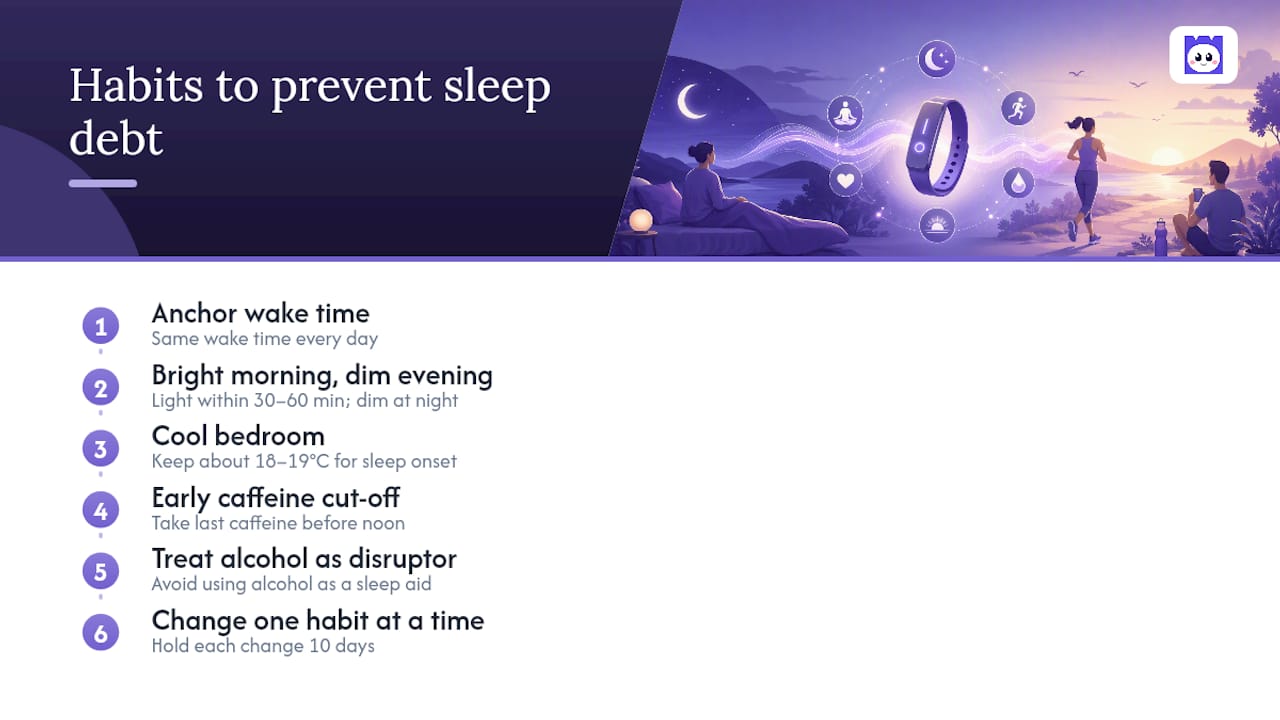
1. Anchor your wake time, not your bedtime. Your circadian rhythm responds far more strongly to a consistent wake time than a consistent bedtime. Sleeping in on days off feels earned, but it shifts your internal clock later and makes the following Monday harder, not easier. Pick one wake time and defend it seven days a week.
2. Get bright light early, dim light late. Morning light, ideally within 30 to 60 minutes of waking, is one of the strongest signals you can send your circadian system. In the evening, do the opposite: dim overhead lights, cut back on bright screens, and let your body’s melatonin production ramp up undisturbed. This single pair of habits does more for sleep onset than almost anything else on this list.

3. Cool the room down. A slightly cooler bedroom, most people find somewhere around 18 to 19°C comfortable, helps your core temperature drop the way it needs to for sleep onset. If you’re lying awake overheating, that’s often a bigger problem than anything you’re doing with your phone.
4. Set a hard caffeine cut-off. Caffeine has a half-life of roughly five to six hours, meaning a 3pm coffee can still be a quarter-strength dose in your system at 9pm. If you’re actively repaying debt, move your last cup to before noon and see what changes within a week.
5. Treat alcohol as a sleep disruptor, not a sleep aid. Alcohol can make you fall asleep faster, then fragments sleep in the second half of the night and suppresses the deep sleep you’re trying to recover. If you’re serious about closing a sleep deficit, alcohol is one of the most measurable disruptions on a sleep graph, and cutting it back even on a few nights a week shows up quickly in how you feel.
6. Change one habit at a time. Trying to fix your wake time, your light exposure, your caffeine cut-off, and your alcohol intake all in the same week is a recipe for giving up on all four. Pick the one causing the most damage, usually caffeine timing or wake-time inconsistency, and hold it for ten days before adding the next.
The common barrier here isn’t knowledge, it’s friction. People know caffeine after 3pm is a bad idea; they do it anyway because the 3pm slump is real and unpleasant. That’s precisely where a short nap or a five-minute walk outside for light exposure earns its place, as a genuine substitute for the coffee rather than a nice-to-have addition to the routine.
How do you measure whether your sleep debt is actually improving?
Vague statements like “I feel a bit better” are hard to act on. A handful of concrete numbers make the recovery trend visible.
- Total sleep time across a rolling seven-day average, not a single night. One bad night against six good ones still nets out fine.
- Sleep efficiency, the percentage of time in bed actually spent asleep. Below roughly 85% consistently suggests the issue is sleep onset or fragmentation, not just quantity.
- Time in bed versus time asleep. A growing gap between these two numbers is often the earliest sign something in your evening routine needs attention.
- Heart rate variability (HRV) trend, which frequently dips during heavy debt and recovers as sleep consolidates.
- A running sleep-debt counter, the kind wearable platforms increasingly build in, which weighs your recent sleep history against your estimated need. One wearable maker’s explainer on sleep debt is a useful primer on how these counters are typically calculated.
The trap most people fall into is overreacting to a single night’s data or fixating on deep sleep percentages as if they were a report card. Sleep stage tracking from consumer devices is genuinely useful as a trend indicator, but it varies night to night for reasons that have nothing to do with debt, room temperature, stress, even what you ate at dinner. Look at the seven-day shape of the graph, not the daily wobble.
This is where an app like Heala fits naturally into the plan. Because it pulls from wearables including Fitbit and WHOOP alongside its own tracking, Heala can weigh your recent sleep pattern against your training load and daily readiness, then suggest a bedtime or nap window that adjusts as your data changes, rather than handing you one static number to aim for.
Wearable-derived sleep-debt counters turn something abstract into a concrete nightly target, but they’re only as useful as your willingness to look at the week, not the night.
A simple weekly log works even without a wearable: note bedtime, wake time, one energy rating out of ten, and whether you napped. Four columns, seven rows, reviewed every Sunday. If you’d rather log with less effort, logging just two days a week still produces a usable trend.
When does sleep debt point to something more serious?
Most sleep debt responds to the plan above. Some cases don’t, and that’s worth knowing before you assume you’re simply not trying hard enough.
Watch for persistent sleepiness that doesn’t improve after a genuine week or two of protected sleep, loud snoring with breathing pauses noticed by a partner, sudden muscle weakness triggered by strong emotion (cataplexy), or a marked shift in mood or memory that doesn’t track with how much you’re sleeping. Any of these, particularly ongoing sleepiness despite doing everything right, is a reason to raise the issue with a doctor rather than push harder on the same routine, since it may point to an underlying condition such as sleep apnoea, which typically requires assessment through a home sleep study or referral to a sleep clinic.
If you’ve been tracking your sleep, bring the data. A week or two of bedtimes, wake times, and any nap patterns gives a clinician a far clearer starting point than a verbal estimate.
What actually keeps people stuck in sleep debt?
The plans people abandon are the ones designed for an ideal week that never arrives. Shift work, a newborn, a demanding season at work, none of that disappears because you’ve decided to fix your sleep. The adaptation that actually holds is smaller: protect the wake time even when the night was messy, take the nap even if it’s only twelve minutes in a car park, and treat one good night as a data point, not proof the whole approach failed.
Small wins compound faster than most people expect. A single 15 minute bedtime shift held for ten days does more than an ambitious plan abandoned after four. Treat this as a habit you’re building, not a debt you’re clearing once and forgetting.
— Kerem
Where Heala fits into your recovery plan
Every step in this plan, protecting your wake time, timing naps correctly, watching the weekly trend rather than one bad night, gets easier with consistent data behind it. This kind of tracking is possible whether or not you wear a device to bed. Its sleep tracking without a watch feature covers you on nights you’d rather skip the wearable, while integrations with Fitbit, WHOOP, Oura, and Apple Health pull in more detail when you do wear one.
Centralising sleep, training load, and recovery data in one place allows suggested bedtime and nap windows to adapt as your week changes, rather than repeating the same generic advice regardless of how your data actually looks. That maps directly onto the plan above: gradual bedtime shifts, a tactical nap window, and a weekly view instead of a nightly panic. If you’re ready to see your own numbers rather than guess at them, start tracking your sleep with Heala and let the recommendations adjust as your recovery progresses.
Sources
- Recovery sleep dynamics — PMC article
- The science behind napping — UW Medicine / Right as Rain
- Tom’s Guide: 1-week schedule to reduce sleep debt
- Chronic sleep loss guidance — Rush University
Recommended
Heala opens 2 October 2026
Free forever — Pro is optional.
Photo food logging, adaptive training, a morning recovery score and a 3D body twin, in one app.