 heala
healaStart From Your Baseline: 500 to 1,000 Step Ladders for Every Age

Start From Your Baseline: 500 to 1,000 Step Ladders for Every Age
Most adults get the biggest return on investment somewhere between 7,000 and 10,000 steps a day, while adults over 65 tend to plateau in benefit around 6,000 to 8,000. Meaningful gains start much lower than either figure. Some cohorts show reduced mortality risk from as few as 2,300 to 3,900 steps daily, and each additional 1,000 steps keeps adding protection. The first move isn’t picking a number. It’s measuring what you actually walk now, for a week or two, before you set anything.
TL;DR:
- Most adults see significant health benefits starting around 2,300 to 3,900 steps daily, with meaningful gains up to 7,000 to 10,000 steps for general health.
- Older adults (65+) typically benefit from 6,000 to 8,000 daily steps, as the relative physiological load is higher, and benefits plateau earlier.
- The relationship between steps and mortality is curvilinear, with the first few thousand steps providing the largest risk reduction, and benefits continuing beyond 10,000 steps.
- Setting personalized step goals involves tracking baseline steps for a week or two, then increasing gradually by 500 to 1,000 steps, adjusted for health conditions or mobility limits.
- Combining walking with habits like post-meal walks, taking calls on foot, and environmental cues effectively raises daily step counts and sustains motivation.
Table of Contents
- Daily step goals by health target: general health, weight loss and longevity
- What step count should you aim for at your age?
- What does the research actually show about steps and mortality?
- How do you set a personalised daily step goal?
- Simple habits that actually raise your daily step count
- How should you track and interpret your step data?
- What should you actually do this week?
- Why hitting your step goal changes your mood, not just your body
- Author perspective: linking evidence to practice
- How Heala turns your step data into a daily plan
- Sources
Daily step goals by health target: general health, weight loss and longevity
The right number depends on what you’re optimising for, and treating every goal the same way is where most step-counting advice falls apart.
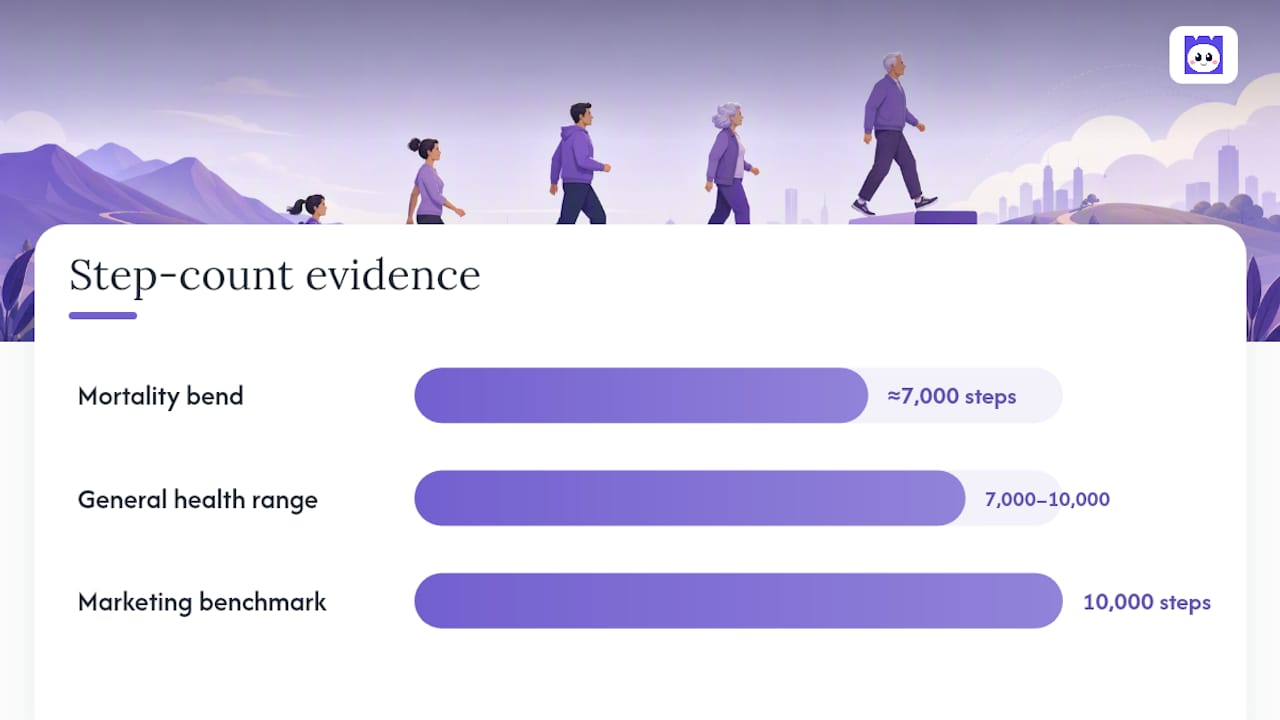
For general health maintenance, the evidence points to roughly 7,000 to 10,000 steps a day for most adults. Heala’s own analysis of the research backs this up: 10,000 steps was a marketing number, invented by a 1960s Japanese pedometer campaign, not a physiological threshold. The real curve in the mortality data bends meaningfully around 7,000.
For weight loss, step count matters, but it’s one lever among several. Walking higher daily step counts creates a modest calorie deficit, though pairing it with dietary tracking tends to produce faster, more consistent results than steps alone.
For fitness and cardiovascular conditioning, volume matters less than intensity once you’re above baseline. The Physical Activity Guidelines for Americans recommend a minimum amount of moderate-intensity activity weekly. Brisk walking that raises your heart rate counts differently than a slow amble to the kitchen.
The takeaway: roughly 2,300 daily steps is linked to lower cardiovascular mortality in some cohorts, but the protective effect keeps climbing well past 10,000 for people chasing fitness rather than baseline health.
- General health: 7,000 to 10,000 steps daily for most adults
- Weight loss: 8,000 to 12,000 steps, combined with nutrition tracking
- Fitness/longevity: volume plus intensity, guided by the 150 minutes/week standard
Anyone managing heart disease, joint problems, or recovering from surgery should treat these ranges as a starting conversation with a clinician, not a fixed prescription.
What step count should you aim for at your age?
Age changes both the achievable number and the relative benefit of hitting it. A teenager and a 70 year old getting the same step count aren’t getting the same physiological payoff.
- Children and adolescents: public health guidance from the NHS generally supports higher activity volumes for younger people, closer to 10,000 to 12,000 steps, reflecting greater baseline mobility and recovery capacity.
- Adults (18 to 64): 7,000 to 10,000 steps covers most general-health goals, with higher ranges suiting those training for fitness or weight loss.
- Older adults (65+): 6,000 to 8,000 steps often delivers a comparable relative benefit, because the physiological load of the same step count is larger for older bodies. Total daily volume tends to matter more than brisk, short bouts in this group.
The reason older adults gain disproportionately from fewer steps comes down to baseline risk. Someone starting from a highly sedentary place has more room to improve, so the same 1,000 step increase buys more protection than it would for someone already active.
Anyone managing frailty, arthritis, or limited mobility should scale targets down further and prioritise consistency over volume. Even lower daily step counts, taken consistently rather than occasionally, outperform a sporadic higher number.
What does the research actually show about steps and mortality?
The relationship between steps and health outcomes isn’t linear. It’s curvilinear: the first few thousand steps deliver the largest jump in benefit, and returns diminish gradually beyond that, without ever fully disappearing.
A pooled analysis covering roughly 227,000 people found that taking at least 3,900 steps daily was linked to lower all-cause mortality, with cardiovascular mortality benefits appearing from around 2,300 steps in some cohorts. Separately, large cohort work reported that each 1,000-step increment corresponded to roughly a 15% reduction in all-cause mortality, with 500-step increments linked to about 7% lower cardiovascular death.
Every additional 1,000 steps a day is associated with an estimated 15% drop in all-cause mortality risk in some large cohort studies, an effect size that holds even for people already fairly active.
A systematic review supporting the Physical Activity Guidelines confirms this inverse relationship extends across multiple outcomes, including cardiovascular events and type 2 diabetes, not just mortality.
Three caveats matter here:
- These are observational cohort studies, not randomised trials, so they show association rather than proof of direct cause.
- Device type (wrist versus phone versus clip pedometer) introduces measurement variability across the underlying studies.
- Populations differ by age, baseline fitness, and health status, so individual results will vary from the average.
How do you set a personalised daily step goal?
Start with data, not a guess. Track your steps for 7 to 14 days using whatever device you already carry, without changing your routine, then calculate the average. That number is your real baseline, not the number you assumed you were hitting.
- Record your baseline. Log daily totals for two weeks and average them, ignoring the highest and lowest outlier days if your routine was unusual.
- Set a step-ladder target. Add 500 to 1,000 steps to your baseline, held for one to two weeks before increasing again. If your baseline is 5,200, aim for 5,700 to 6,200 next.
- Adjust for extremes. If you’re under 3,000 steps currently, start with smaller 250 to 500 step increases every few days to avoid soreness or discouragement. If you’re already above 9,000, shift focus to intensity (brisk pace, hills) rather than pure volume.
- Reassess every two to three weeks. Recalculate your rolling average and repeat the ladder.
Pro Tip: Pair your step increases with progressive overload principles from strength training. Volume is only one dial among several. Adjusting frequency and intensity alongside steps prevents plateaus.
Consult a clinician before increasing activity substantially if you have cardiovascular disease, uncontrolled diabetes, or a recent injury.
Simple habits that actually raise your daily step count
Nobody sustains a step goal through willpower alone. The habits that work attach walking to something you’re already doing.
- Walk after meals, not before. Post-meal walking moves glucose more effectively than pre-meal walking, giving you a metabolic reason beyond the step count itself.
- Take calls on your feet. A 15-minute call becomes 1,500 to 2,000 free steps.
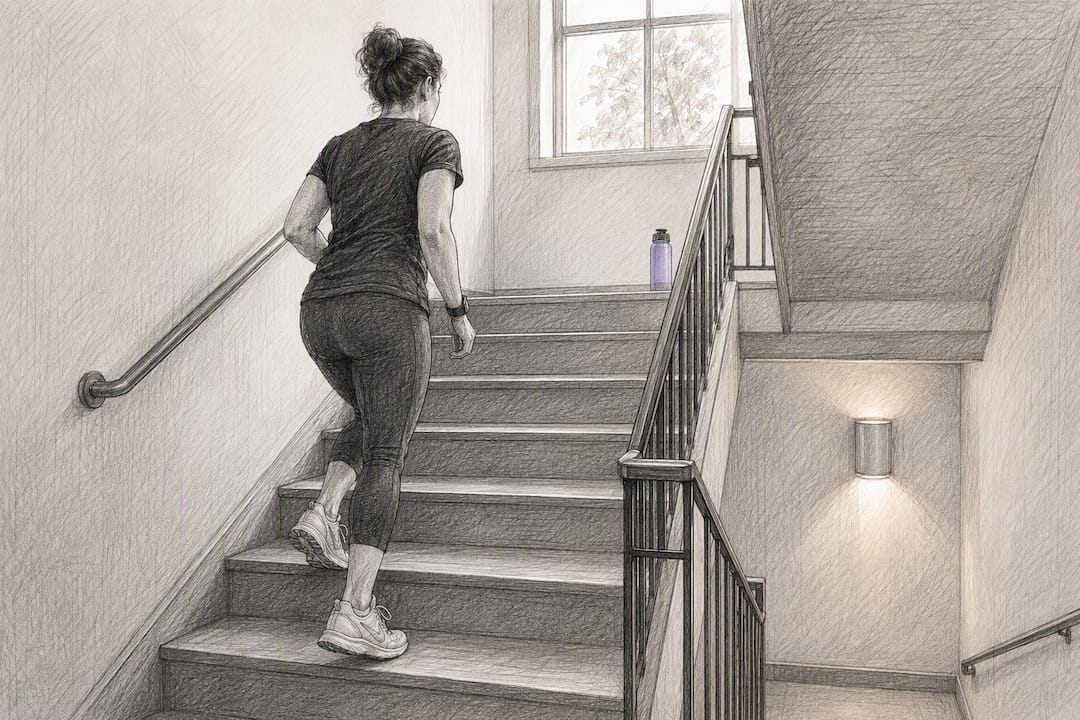
- Use the stairs and park further out. Small, repeated environmental nudges add up faster than one deliberate long walk.
- Break up sitting hourly. A 5-minute walk every hour outperforms a single 30-minute block for glucose control and circulation.
- Run errands on foot when the distance allows it, rather than defaulting to the car.
Pro Tip: Habit stacking, attaching a new walk to an existing routine like your morning coffee or the school run, works better than relying on motivation, according to heart health guidance from the BHF. For more structured behaviour-change tactics, the Fitness Flow blog covers sustainable habit-based approaches worth exploring.
Bad weather and travel are the two biggest disruptors. Keep a fallback plan, an indoor stair circuit or a hotel treadmill session, so a rainy week doesn’t reset your progress to zero.
How should you track and interpret your step data?
Track for at least 7 to 14 days before drawing conclusions. A single day tells you almost nothing, since device variability and daily routine changes can swing your number by thousands of steps.
Wrist-worn trackers and phones often disagree, sometimes by 15% or more, because wrist devices catch arm movement that phones in pockets miss, and phones left on a desk miss steps entirely. Pick one device and stick with it for consistency rather than chasing the “most accurate” option.
- Smooth your data with a 7-day rolling average rather than reacting to single-day spikes or dips.
- Look beyond raw step count at intensity (pace), bout length (are steps in one 20-minute block or scattered?), and hourly distribution across the day.
- Tracker use itself changes behaviour. Personalised, prompting-based trackers increased daily steps by an average of 1,850 in previously inactive people.
Some health apps centralise data from devices like Fitbit, WHOOP, and Oura, offering adaptive daily plans that adjust recommendations based on sleep quality and recovery readiness rather than treating every day identically.
What should you actually do this week?
Start simple, and don’t overthink week one.
- Track your current steps for 7 days without changing anything.
- Calculate your average and set a target 500 to 1,000 steps above it.
- Schedule two mini-walks daily, ideally after meals.
- Recheck your average in two weeks and adjust the ladder.
If you have a cardiovascular condition or mobility limitation, confirm your plan with a clinician first. Small, consistent gains compound faster than most people expect.
Why hitting your step goal changes your mood, not just your body
Meeting a daily step target does something that pure exercise intensity often doesn’t: it delivers a small, repeatable win you can point to every single day. That consistency matters more for mood than most people assume, because psychological benefit tends to track adherence and completion, not just total volume.
The mechanism is partly behavioural. A step goal is binary. You either hit it or you didn’t, and that clarity removes the ambiguity that makes other health habits feel murky. Compare it to “eat healthier,” which has no clear finish line, versus “hit 8,000 steps,” which does. That clean feedback loop is part of why step tracking sticks for people who’ve abandoned other fitness habits.
There’s also a compounding effect across the day. Short walks, particularly outdoors, break up long stretches of sitting or screen time, and that break itself tends to lower stress and improve focus for the following hour. Walking after meals or during a stressful afternoon isn’t just metabolically useful, it’s a built-in reset button that doesn’t require special equipment or a gym membership.
The risk is treating the number as a pass/fail moral judgment rather than a rough guide. Missing your target on a busy or unwell day isn’t a failure, it’s data. Readers who treat step goals as flexible feedback, rather than a strict daily verdict, tend to sustain the habit for years rather than weeks. That distinction, between a target and a test, is worth holding onto.
Author perspective: linking evidence to practice
The step-count debate spends too much energy arguing over the “right” number and not enough on the mechanism that actually changes behaviour: small, visible progress. Heala’s own research into thresholds like the 7,000-step curve and post-meal walking timing points the same direction as the wider literature. Precision matters less than direction. Track your baseline, nudge it up, and let the data tell you what’s sustainable rather than guessing.
— Kerem
How Heala turns your step data into a daily plan
Manually averaging two weeks of step counts, then remembering to bump your target every fortnight, is exactly the kind of small admin task that quietly derails good intentions. The app centralises step data from various devices automatically and adjusts daily targets based on recovery and sleep, so a rough night doesn’t get treated the same as a well-rested one.

You don’t need the app to follow the step-ladder method outlined above. It works with a notebook and a phone counter. But if you’d rather have your targets adjust themselves as your sleep, hydration, and training load shift, that’s precisely what the Heala app is built to do. Readers focused on weight-loss goals specifically can also pair step tracking with Heala’s weight trend tracking to see how activity and diet interact over weeks rather than single days. Download it and log your first baseline week today.
This article is general information, not a substitute for advice from a qualified doctor. Consult a qualified healthcare professional about your own circumstances before acting on anything here.
Sources
- Daily step count and health outcomes (meta-analysis)
- Large study finds the sweet spot for daily step goals — Harvard Health
- How many steps/day are enough? For older adults and special populations — IJBNPA
- Physical Activity Guidelines for Americans, 2nd edition
- Effect of consumer-based activity trackers on physical activity — systematic review
Recommended
Heala opens 2 October 2026
Free forever — Pro is optional.
Photo food logging, adaptive training, a morning recovery score and a 3D body twin, in one app.