 heala
healaZone 2 training: 45 minute sessions, lab methods and wearable plans
Zone 2 training: 45 minute sessions, lab methods and wearable plans
Zone 2 is the aerobic intensity just below your first lactate threshold, where you can hold a conversation but feel a slight effort behind it. It builds the mitochondrial and fat-burning machinery that underpins endurance, with almost no fatigue cost. To start today, run, ride or row at a pace where you could speak in full sentences but not sing, and hold that for 30 minutes.
TL;DR:
- Relying solely on heart rate percentages can be misleading due to cardiac drift, especially during long sessions in heat or dehydration.
- Consistent tracking of resting heart rate over weeks offers a more accurate measure for personalized zone 2 training adjustments than one-time testing or formulas.
- Sessions shorter than 45 minutes typically serve as warm-ups, with 45 minutes or more needed to induce meaningful mitochondrial and fat-burning adaptations.
- In weekly training, most runners and cyclists should aim for an 80/20 split, prioritizing zone 2 volume unless time constraints make intervals more effective.
- Most training advice emphasizes time and consistency over precise formulas, with wearable-based tracking and recovery data offering better zone control.
Table of Contents
- What is zone 2 training, physiologically speaking?
- What are the benefits of zone 2 training?
- How do you find your personal zone 2?
- How should you programme zone 2 sessions?
- What is the “grey zone” and why does it hurt your training?
- What do zone 2 workouts look like in practice?
- How does Heala fit into a zone 2 block?
- Why most zone 2 advice misses the point
- Build your zone 2 habit with Heala
- Sources
- FAQ
What is zone 2 training, physiologically speaking?
Zone 2 sits just below LT1, or VT1 if you prefer the ventilatory framing. That’s the point where your blood lactate begins to accumulate faster than your body can clear it, typically somewhere around 1 to 2 mmol/L for most people. Push past that line and you’re no longer training the aerobic system in the way that matters. You’re doing something else entirely, usually something less useful.
Expert consensus groups describe zone 2 as sitting just below this first threshold. It favours long, continuous or variable sessions rather than short bursts. That’s a physiological definition, not a heart-rate number, and the distinction matters more than most training apps let on.
Different zone models describe roughly the same territory with different language:
- Three-zone models (used by many endurance coaches) call this simply “zone 1 to 2”, the easy aerobic band below threshold.
- Five-zone models (common in cycling and running apps) usually place zone 2 as the second band from the bottom, just under moderate effort.
- Clinical and public health language often just says “moderate-intensity exercise”, which overlaps substantially with the same physiological state.
Heart-rate percentages are a useful proxy, not the thing itself. Your heart rate can drift upward over a long session even when your effort and pace stay constant, a phenomenon called cardiac drift, driven by rising core temperature and fluid loss. That’s why relying purely on a number can nudge you out of zone 2 without you realising it, particularly on longer runs or rides in the heat.
What are the benefits of zone 2 training?
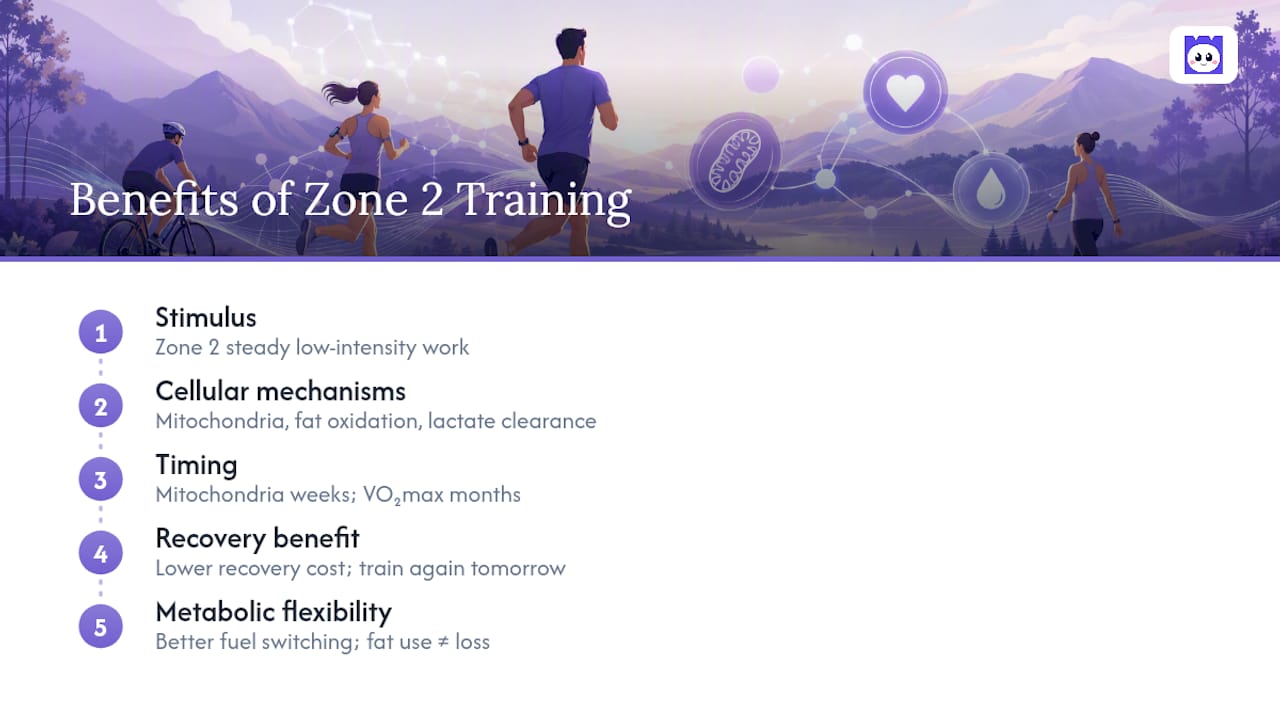
The strongest argument for zone 2 isn’t speed. It’s what happens inside the cell. Sustained low-intensity work drives mitochondrial biogenesis, improved fat oxidation and more efficient lactate clearance, the three mechanisms that actually make you a better endurance athlete over months, not weeks.
Measurable mitochondrial changes can appear within a few weeks of consistent training, according to practitioner-reported timelines, with VO₂max improvements typically following after some months. That’s an important sequencing point: the cellular adaptations arrive well before anything visible changes.
There’s a secondary benefit that’s easy to overlook: recovery cost. A hard interval session leaves you fatigued for a day, sometimes two. A well-paced zone 2 session leaves you ready to train again tomorrow, which is why it can be layered in far more frequently than high-intensity work without digging a fatigue hole.
Zone 2 also appears to support metabolic flexibility, the ability to switch between burning fat and carbohydrate depending on demand, which has knock-on relevance for long-term cardiometabolic health, not just race times. One caveat worth stating plainly: burning a higher proportion of fat during a zone 2 session doesn’t automatically mean fat loss. Weight change is still governed by total energy balance over time, not the fuel source used in any single workout.
How do you find your personal zone 2?
You have three broad options, ranging from free and immediate to precise and paid. None of them is wrong. They just trade off convenience against accuracy.
- The talk test. If you can speak in full sentences but wouldn’t want to sing, you’re roughly in zone 2. This remains one of the most reliable low-tech methods because it responds instantly to heat, fatigue and terrain, which a fixed heart-rate number cannot do.
- HR percentage formulas. The classic 220 minus age formula estimates a 40-year-old’s max heart rate at 180 bpm, giving a zone 2 window of roughly 108 to 126 bpm at 60 to 70% max. The Tanaka formula (208 minus 0.7 x age) tends to run slightly higher for older adults, giving that same 40-year-old a max estimate closer to 180 bpm. The Karvonen method adds resting heart rate into the equation: take (max HR minus resting HR) x 0.6 to 0.7, then add resting HR back on, which personalises the range considerably better than a flat percentage.
- Lactate or metabolic testing. A finger-prick lactate protocol, typically a 10-minute warm-up followed by repeated 8 to 10 minute steady efforts with blood draws, pinpoints the exact intensity where lactate first climbs toward roughly 2.0 mmol/L. Lab-based lactate or metabolic cart testing usually costs somewhere between £80 and £200 depending on the provider and location, and it’s the closest you’ll get to a true individual answer rather than a population estimate.
Pro Tip: Track your resting heart rate for a week before running any formula. A lower resting heart rate sharpens the Karvonen calculation considerably, and it’s one of the cheapest fitness markers you can track without any equipment at all.
How should you programme zone 2 sessions?
Session length matters more than people expect. Anything under 45 minutes tends to function as a warm-up rather than a genuine mitochondrial stimulus, which is why practitioner guidance consistently points to 45 minutes as the practical floor for a session that actually earns its place in a training week.
Weekly volume depends heavily on your goals and your available time:
- Recreational exercisers: two to three sessions per week, 45 to 60 minutes each, gets most of the health and endurance benefit without eating into your week.
- Amateur endurance athletes: three to five hours weekly, often built from a mix of 60 to 90-minute sessions plus one longer effort.
- Competitive or elite endurance athletes: frequently six to ten-plus hours weekly, though this is a training-load decision made with a coach, not something to reverse-engineer from an article.
If your weekly time is genuinely limited, the calculus shifts. High-intensity work can offer more physiological return per minute than additional zone 2 volume when time, not fatigue, is your binding constraint. Zone 2’s real advantage shows up when fatigue management matters, letting you accumulate aerobic volume without digging into your recovery reserves the way intervals do.
A sensible split for most people mixing zone 2 with harder work follows something close to an 80/20 pattern: roughly 80% of weekly training time at low intensity, 20% at moderate to high intensity, rather than the more even split most people default to instinctively.
Pro Tip: Progress the block by adding time before adding intensity. An extra 10 minutes onto an existing session is a safer next step than pushing the pace within the same duration.

What is the “grey zone” and why does it hurt your training?
The grey zone sits between zone 2 and genuine threshold work: too hard to be truly easy, too easy to drive the adaptations that hard intervals produce. It’s the pace that feels productive because you’re sweating, but research and coaching consensus both flag it as the intensity that yields the weakest training response of any zone on the spectrum.
Most people land here through ego pace: running or riding a touch faster than their zone 2 window simply because it feels slow otherwise. A few practical fixes keep you honest:
- Check your RPE every 10 to 15 minutes, not just your heart-rate number, since perceived effort catches drift that a lagging monitor sometimes misses.
- On long sessions, if your heart rate climbs but your pace hasn’t, ease off rather than chasing the original number, since internal load, not external pace, is what you’re managing.
- Break sessions longer than 90 minutes with brief walking or coasting segments to manage heat and fluid loss before drift sets in.
What do zone 2 workouts look like in practice?
The structure barely changes across disciplines. What changes is the pacing cue you use to stay in the window.
- Running (45 to 60 minutes): a steady, conversational pace throughout, checking every 10 minutes with the talk test rather than obsessing over splits.
- Cycling (90 to 180 minutes): a long, flat-to-rolling ride at consistent power or perceived effort, using GPS tracking to confirm your average pace held steady rather than crept upward.
- Gym cardio circuit (45 to 60 minutes): rotate between a rower, bike and incline treadmill in 15-minute blocks, which keeps the same joints from taking all the load on a long single-modality session.
A fasted morning session works well for shorter zone 2 efforts under an hour, but longer sessions benefit from a small carbohydrate top-up beforehand to protect quality in the final third. If you’re pairing zone 2 with strength work on the same day, do the strength session first when fresh, then the aerobic work afterward at an easy effort. Doing it the other way round usually compromises your lifting more than your aerobic pace.
How does Heala fit into a zone 2 block?
Some health apps pull in heart-rate and resting heart-rate data from wearables like Fitbit, WHOOP, Oura and Apple Health, which matters because Karvonen-based zone 2 calculations depend on an accurate resting figure that shifts over weeks, not a one-off measurement.
A typical workflow for a training block looks like this:
- Sync your wearable so resting heart rate trends are visible week to week, not just as a single snapshot.
- Log each zone 2 session so weekly time in zone accumulates automatically, rather than relying on memory or a spreadsheet.
- Let adaptive daily plans account for recovery signals like heart rate variability, so a day showing signs of fatigue can be identified before you push a session that should have been easy.
- Review resting heart rate trends monthly to assess potential aerobic base improvements.
Why most zone 2 advice misses the point
The internet’s obsession with zone 2 has produced a strange side effect: people treat the heart-rate number as the goal, rather than the physiological state it’s meant to approximate. That’s backwards. A 220-minus-age formula is a rough guess dressed up as precision, and anyone training seriously for more than a season should treat it as a starting point to refine, not a fixed target to defend.
The bigger gap in conventional advice is time allocation. Plenty of guides tell you zone 2 is good for you, then leave you to figure out how five hours of easy training fits around a job and a family. It often doesn’t, and that’s fine. The honest answer, as Peter Attia has argued, is that when time is scarce, intervals can outperform additional easy volume on a per-minute basis. Zone 2 earns its place when fatigue, not time, is what’s limiting you.
If there’s one thing worth prioritising above formulas and testing protocols, it’s consistency in tracking your own resting heart rate and session length over months. That single habit tells you more about whether the training is working than any single session ever will.
— Kerem
Build your zone 2 habit with Heala
Certain apps offer features that turn a zone 2 plan into a habit by syncing with wearables so resting heart rate, session time and recovery signals sit in one place instead of scattered across several apps.

Rather than guessing your zone from a formula and hoping it still applies next month, Heala tracks how your resting heart rate trends over your training block and adapts your daily plan around what your recovery data actually shows. If you’re comparing options, see how Heala stacks up against a WHOOP strap alone for this exact use case. Start with the free tier and connect your first wearable today at Heala.
Sources
FAQ
What is a zone 2 workout?
A zone 2 workout is sustained aerobic exercise at an intensity just below your first lactate or ventilatory threshold, where you can hold a conversation but feel a mild effort underneath it. It typically corresponds to 60 to 70% of maximum heart rate, and it can be done running, cycling, rowing or on any steady cardio machine.
Does zone 2 actually burn fat?
Zone 2 does increase the proportion of energy drawn from fat during the session itself, but overall weight change is still governed by total energy balance over time, not the fuel source used in any single workout. Its real value lies in improved fat oxidation capacity and metabolic flexibility over months, not a fat-burning shortcut in a single session.
How long should you zone 2 train for?
Aim for sessions of at least 45 minutes, since shorter efforts tend to function as warm-ups rather than a genuine mitochondrial stimulus. Recreational exercisers typically do well with two to three sessions weekly, while endurance athletes often build toward several hours across the week.
Is it better to train in zone 2 or zone 3?
For most weekly training, zone 2 should dominate, with harder zone 3 to 4 work making up a smaller share, often close to an 80/20 split. Zone 3 sits closer to the “grey zone”, an intensity that’s frequently too hard to build a large aerobic base and too easy to drive the adaptations proper threshold or interval work produces.
Can Heala help me stay in my zone 2 range?
Heala syncs with wearables like Fitbit, WHOOP and Oura to track heart rate and resting heart rate trends over time, which supports more accurate Karvonen-based zone calculations than a flat age formula. Current pricing and free tier details are available directly on Heala.
Recommended
Heala opens 1 October 2026
Free forever — Pro is optional.
Photo food logging, adaptive training, a morning recovery score and a 3D body twin, in one app.