 heala
healaRaise VO2 Max in 8 Weeks for Busy Science Minded Athletes

Raise VO2 Max in 8 Weeks for Busy Science Minded Athletes
The fastest reliably repeatable way to raise VO2 max is to combine steady zone 2 base work with one to two high-intensity interval sessions a week, such as the Norwegian 4x4, alongside two strength sessions and genuine recovery. Measurable gains are typically seen within a few weeks, provided progression is gradual and recovery isn’t an afterthought.
TL;DR:
- Combining zone 2 base work with one to two high-intensity interval sessions weekly, such as the Norwegian 4x4, effectively improves VO2 max within a few weeks.
- Longer intervals of three to five minutes at high intensity yield greater VO2 max gains than short, maximal efforts like Tabata, with 4x4 being the most studied and effective protocol.
- Progression should focus on increasing time at high intensity or extending intervals gradually, with no more than two hard sessions per week to prevent burnout.
- Adequate recovery, including strength training and sleep, supports cardiovascular improvements, while avoiding training in the grey zone prevents progress stalls.
- Wearables provide trend tracking, but lab or submax tests are needed for precise VO2 max measurement, and retesting every eight to twelve weeks captures meaningful improvements.
Table of Contents
- What is VO2 max and why does improving it matter?
- How is VO2 max measured, and what do wearables estimate?
- What training principles actually drive VO2 max gains?
- Which interval protocols work best: Norwegian 4x4, long intervals, or Tabata?
- What does an 8-week VO2 max training plan look like?
- How do strength training and recovery support VO2 max gains?
- Why does VO2 max progress stall, and how do you fix it?
- How do you track progress and know when to retest?
- What nutritional strategies actually support VO2 max gains?
- How do age, genetics, and sex affect VO2 max training?
- How do altitude and temperature affect VO2 max training?
- Does cross-training improve VO2 max as effectively as running?
- Kerem and Heala: how we apply this research in practice
- How Heala helps you train smarter for VO2 max gains
- Sources
What is VO2 max and why does improving it matter?
VO2 max is the maximum volume of oxygen your body can use during intense exercise, measured in millilitres per kilogram of body weight per minute (ml/kg/min). That “per kilogram” detail matters: it’s your relative VO2 max, not your absolute oxygen consumption, that predicts performance and drops when body fat rises without a fitness change.
A higher VO2 max correlates with lower cardiovascular risk and greater longevity, independent of other fitness markers, according to Harvard Health. For athletes, it sets your aerobic ceiling and determines how fast you can sustain effort before fatigue sets in. Genetics account for a meaningful share of your starting point, but training, body composition, and consistency remain firmly within your control.
How is VO2 max measured, and what do wearables estimate?
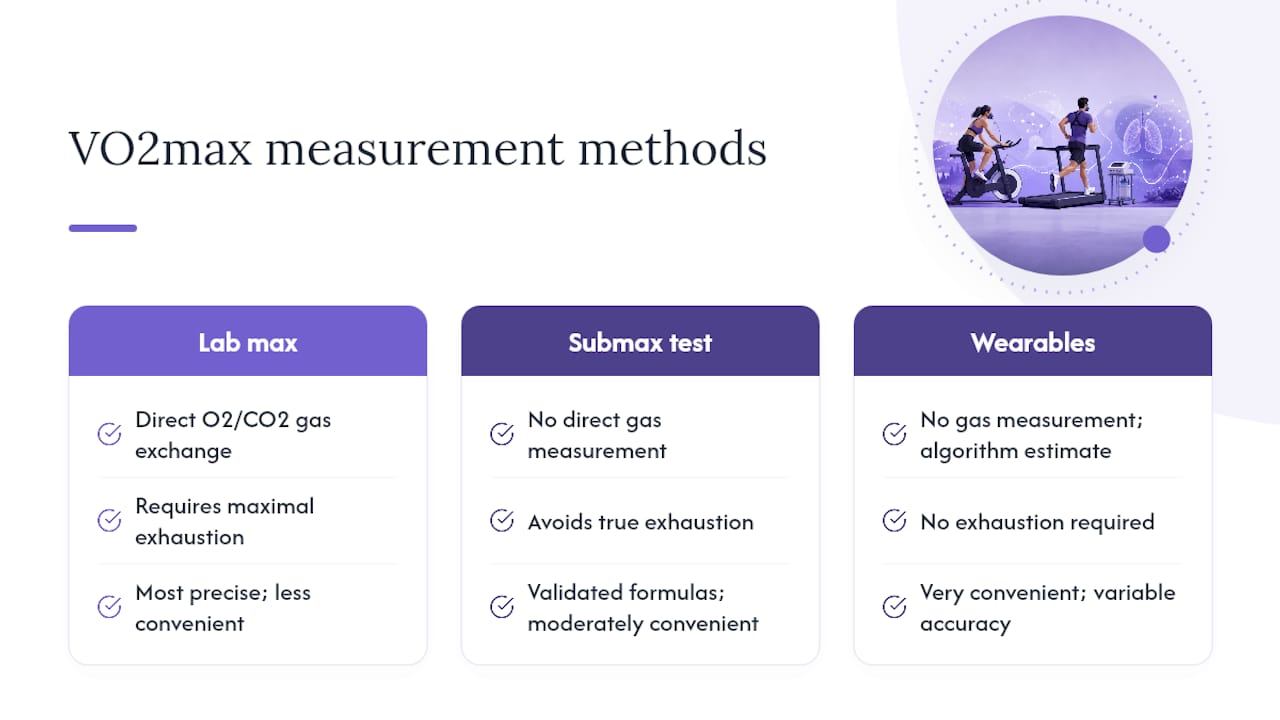
The gold standard is a laboratory maximal test using gas exchange analysis, where you run or cycle to exhaustion while breathing through a mask that measures oxygen and carbon dioxide directly. Submaximal tests estimate VO2 max from heart rate and workload using validated formulas, avoiding the need to reach true exhaustion.
Wearables estimate VO2 max from heart rate, pace, and personal data rather than measuring gas exchange at all. That convenience comes with accuracy limits, and algorithm-based estimates can vary noticeably between devices and conditions. Use a wearable to track trends over weeks, and reserve lab or submax testing for a genuinely precise number.
What training principles actually drive VO2 max gains?
The research consensus is fairly blunt: intensity matters more than volume alone. Meta-analyses comparing high-intensity interval training against moderate continuous training consistently find HIIT produces larger VO2 max gains, often described as roughly double in some populations, for a similar or smaller time investment.
The mechanism explains why. Moderate continuous training, sitting largely in zone 2, drives peripheral adaptations: more capillaries, more mitochondria, better fat oxidation at the muscle level. High-intensity work above 85 to 90% of maximum heart rate pushes central adaptations instead, principally increasing stroke volume, the amount of blood your heart pumps per beat, which raises the ceiling on oxygen delivery itself.
That’s the case for the polarized 80/20 model, where roughly 80% of weekly training minutes sit at low intensity and 20% at high intensity, a structure repeatedly observed in elite training and supported by controlled trials.
Why not just do more hard sessions? Because the total accumulated time spent near your VO2 max ceiling, not the number of sessions, seems to drive the adaptation, and that time is only sustainable when most of your week is spent recovering easily rather than accumulating fatigue.
- Zone 2 builds the aerobic engine: mitochondria, capillary density, fat-burning efficiency.
- High-intensity intervals raise the ceiling: cardiac output, stroke volume, oxygen delivery.
- Polarized structure lets you sustain both without burning out.
Which interval protocols work best: Norwegian 4x4, long intervals, or Tabata?
Not all intervals are equal for this specific goal. Trials comparing interval lengths generally find that longer intervals of three to five minutes produce bigger VO2 max changes than very short, maximal efforts like Tabata. That’s because longer intervals allow more accumulated time at a high percentage of VO2 max per session, which appears to be the real driver of adaptation.
Here’s how the three most-cited protocols compare:
- Norwegian 4x4: Four intervals of four minutes at 85 to 95% of maximum heart rate, separated by three minutes of active recovery. This is the most heavily studied VO2 max protocol and produces some of the largest documented effect sizes. A full session, warm up included, runs about 35 to 40 minutes.
- Long intervals (3 to 5 minutes): A flexible variant of the same principle. Three to six repetitions at a hard but sustainable effort, with recovery roughly equal to or slightly shorter than the work interval. Ideal if 4x4 feels too rigid or too long early on.
- Tabata: Twenty seconds maximal effort, ten seconds rest, repeated for four minutes. Brutally efficient for anaerobic capacity and time-crunched sessions, but the evidence for VO2 max specifically favours the longer formats above.
If you’re new to structured intervals, start with three intervals instead of four and extend recovery to four minutes. Cap high-intensity sessions at one to two per week; more than that increases injury and burnout risk without proportionally better returns.
Pro Tip: If a 4x4 session at your target heart rate stops feeling “very hard” by week three or four, progress by adding a fifth interval or shortening recovery to two and a half minutes, rather than simply pushing pace on every session.
What does an 8-week VO2 max training plan look like?
Your available hours dictate the shape of the plan, not the ambition of it. Three tiers work well depending on your weekly time budget.
- 2 hours a week: One zone 2 session (40 to 60 minutes) and one interval session (Norwegian 4x4 or long intervals). Add ten minutes of bodyweight strength work after the easy session.
- 3 to 4 hours a week: Two zone 2 sessions, one interval session, and one dedicated strength session using compound lifts. This is the sweet spot for most people chasing a genuine polarized structure.
- 5+ hours a week: Three zone 2 sessions, one to two interval sessions (never both hard days back to back), two strength sessions, and one optional easy recovery session or mobility work.
Across all three, progress by extending zone 2 duration gradually, adding one interval repetition every two to three weeks, or trimming recovery time between intervals once effort no longer feels maximal. Place a deload week, roughly 40% less volume, around week four to prevent accumulated fatigue from masking real progress.
Retest at the end of week eight using the same protocol and conditions you started with. Detectable VO2 max shifts often show up within four to six weeks, with the largest gains typically visible by weeks eight to twelve as cardiac adaptations catch up to earlier metabolic ones.
How do strength training and recovery support VO2 max gains?
Two strength sessions a week, built around squats, deadlifts, lunges, and rows, improve running and cycling economy and guard against age-related muscle loss. Research on concurrent training finds resistance work doesn’t blunt aerobic gains, it complements them, particularly for runners whose economy improves as leg strength increases.
Sleep of seven to nine hours a night is when much of the cardiovascular adaptation from interval sessions actually consolidates. Nutrition needs to cover your energy expenditure with adequate protein for muscle repair, and hydration status affects how honestly your heart rate reflects true effort during intervals.
Planned deloads, lighter weeks every four to eight weeks, aren’t a step backwards. They’re what allows the next training block to actually land as an adaptation rather than added fatigue on top of unresolved fatigue.
Why does VO2 max progress stall, and how do you fix it?
Most plateaus trace back to one habit: training in the “grey zone,” a moderately hard pace that’s too intense to count as genuine recovery and too easy to drive real adaptation. Coaching and review evidence consistently flags this as the leading cause of stalled progress, alongside insufficient recovery between hard sessions.
The fix is disciplined polarization: make easy days properly easy, ideally at a pace where conversation feels comfortable, and make hard days properly hard. Splitting the difference on both defeats the purpose of either.
- Audit your “easy” runs or rides; if your heart rate creeps above zone 2, slow down, not just occasionally, every time.
- Add progressive overload deliberately: one more interval, a slightly longer session, never both in the same week.
- Watch for overtraining signs: persistently elevated resting heart rate, poor sleep quality, and irritability are earlier warnings than a stalled VO2 max number itself.
How do you track progress and know when to retest?
Field tests give you a practical proxy without lab equipment. The Cooper test (maximum distance in twelve minutes), a timed 5K, or a submaximal ramp test on a bike all correlate well enough with lab values to track change over time.
Retest every eight to twelve weeks rather than weekly. Gains vary by training status: a sedentary starting point often sees larger percentage improvements than someone already trained, though genuinely trainable gains are possible at almost any baseline.
Treat wearable VO2 max estimates as directional, not diagnostic. A single reading carries meaningful error margins, but a consistent upward trend across several weeks, tested under similar conditions, tells you the training is working.
What nutritional strategies actually support VO2 max gains?
Training adaptation runs on energy availability. Chronic under-eating, common among people trying to lose weight and improve fitness simultaneously, blunts the mitochondrial and cardiovascular adaptations that interval training is meant to trigger, simply because the body lacks the resources to rebuild.
Carbohydrate availability matters specifically around interval sessions. Glycogen depletion going into a Norwegian 4x4 session means you can’t hit the target heart rate zones for the full session duration, which undermines the entire point of the workout. A modest carbohydrate-rich meal two to three hours before a hard session, and simple carbohydrates within thirty minutes after, support both performance that day and recovery for the next one.
Protein intake, spread across the day rather than loaded into one meal, supports the muscular adaptations from strength sessions that protect running and cycling economy. Iron status deserves specific attention, particularly for endurance athletes and menstruating women, since iron deficiency directly limits oxygen-carrying capacity and can flatten VO2 max progress regardless of how well-structured the training is.
Hydration affects the numbers you see more than most people realise. Even mild dehydration elevates heart rate at a given pace, which can make a genuinely easy zone 2 session read as harder than it is, nudging you unintentionally into the grey zone discussed earlier. Weight changes also skew relative VO2 max readings independent of any actual fitness change, since the metric divides by body mass. Tracking your weight trend rather than reacting to daily fluctuations gives a clearer picture of whether a VO2 max shift reflects real adaptation or simply a change on the scale.
How do age, genetics, and sex affect VO2 max training?
VO2 max typically declines with age after your late twenties or early thirties, largely driven by reduced maximum heart rate and declining muscle mass. The encouraging finding is that trainability persists well into older age: the achievable ceiling drops, but the capacity to improve relative to your own starting point doesn’t disappear. Older adults following structured interval and strength programmes often see percentage gains comparable to younger trainees, even if their absolute numbers sit lower.
Genetics set a meaningful share of your baseline VO2 max, affecting everything from cardiac size to muscle fibre type distribution and mitochondrial density you’re born with. Twin studies consistently find a substantial heritable component, but genetics determine your ceiling and your responsiveness to training, not whether training works at all. Some people are simply “high responders” who see larger gains from the same programme as others, a frustrating but well-documented reality rather than a training failure.
Sex differences show up primarily through body composition and haemoglobin concentration. Men typically carry higher haemoglobin levels, improving oxygen-carrying capacity, and often carry a higher proportion of lean mass relative to total body weight, both of which push average relative VO2 max higher in men than women at a comparable training status. These are population-level averages, though, and individual variation within each sex is often larger than the average difference between them. Neither factor changes the training principles: zone 2 base work, targeted intervals, and strength training drive adaptation regardless of your starting demographic profile.
How do altitude and temperature affect VO2 max training?
Training at altitude reduces the oxygen available per breath, which lowers your effective VO2 max during the session itself, sometimes by a noticeable margin above roughly 2,000 metres. This isn’t purely a disadvantage. Sustained altitude exposure stimulates increased red blood cell production, which is precisely why altitude training camps remain popular among endurance athletes chasing sea-level performance gains. For most readers training at a fixed altitude, the practical takeaway is simpler: don’t compare a VO2 max reading taken on a mountain holiday with one from a session at home. The numbers aren’t measuring the same conditions.
Heat carries its own penalty. Exercising in high temperatures diverts blood flow to the skin for cooling, competing directly with the muscles for the same limited blood supply, which raises heart rate at a given pace and can make a genuinely easy zone 2 session drift into harder territory without any change in actual effort. This matters for both training and testing: a VO2 max field test run in high heat and humidity will likely underestimate true fitness compared with the same test on a cool, dry day.
Cold, dry air presents a milder but real issue for some, particularly triggering airway constriction in people prone to exercise-induced bronchoconstriction. None of this means you should avoid training outside typical conditions. It means interpreting a wearable trend or a field test result requires accounting for the environment the reading was taken in, not just the number itself.
Does cross-training improve VO2 max as effectively as running?
Cross-training, using cycling, rowing, swimming, or the elliptical alongside or instead of running, can improve VO2 max effectively, provided the training intensity and structure follow the same principles: sufficient zone 2 volume plus targeted high-intensity intervals.
VO2 max adaptations transfer reasonably well across modalities because the central adaptations, particularly increased stroke volume and cardiac output, aren’t specific to a single sport. A rower who builds a strong aerobic base through polarized training will see genuine VO2 max improvement that partially carries over to running fitness, even without running training specifically.
Where cross-training earns its place is injury management and joint stress reduction. Runners prone to overuse injuries can maintain, and sometimes improve, VO2 max through cycling or swimming intervals while allowing running-specific tissues to recover. The trade-off is sport-specific economy: your VO2 max might hold steady on a bike, but your running pace at that same VO2 max will likely need some re-adaptation once you return to the road, since neuromuscular efficiency in a specific movement pattern doesn’t transfer as completely as the underlying cardiovascular fitness does.
For most readers, mixing two cardio modalities across a week, rather than relying on a single sport exclusively, spreads mechanical load while still hitting the intensity distribution that drives VO2 max gains.
Kerem and Heala: how we apply this research in practice
What strikes me most about this evidence base is how much of it hinges on consistency most people can’t self-monitor accurately, especially the boundary between a genuinely easy zone 2 day and a grey-zone day that quietly sabotages the next hard session.
That’s the gap Heala is built to close. By syncing wearable data from devices like Fitbit or WHOOP, it flags when yesterday’s effort or poor sleep means today’s planned interval session should shift, adjusting the polarized structure automatically rather than leaving that judgement call to guesswork on a tired morning.
How Heala helps you train smarter for VO2 max gains
Running a genuinely polarized week, with easy days easy and hard days hard, gets difficult fast when you’re manually juggling heart rate zones, recovery scores, and training logs across different apps. Some health and fitness apps centralise this data and can build adaptive daily plans around your actual readiness rather than a fixed schedule.

That means your Norwegian 4x4 session gets nudged to a rest day when your recovery data flags accumulated fatigue, and your zone 2 sessions get flagged if your heart rate drifts into that grey zone this article warned against. Heala also tracks your weight trend alongside training load, useful given how much relative VO2 max depends on body mass, and monitors sleep quality without requiring a dedicated sleep tracker.
If you want a single place to run this plan without spreadsheets or guesswork, start with Heala and connect your existing wearable to see your first adaptive week.
This article is general information, not a substitute for advice from a qualified doctor. Consult a qualified healthcare professional about your own circumstances before acting on anything here.
Sources
- High‑intensity interval training and VO2 max (PMC article)
- How to improve your VO2Max: an evidence-based guide
- VO2 max: what it is and how to improve it — Harvard Health
Recommended
Heala opens 2 October 2026
Free forever — Pro is optional.
Photo food logging, adaptive training, a morning recovery score and a 3D body twin, in one app.