 heala
heala5 Medically Backed Heart Rate Zones That Shift With Your Recovery
5 Medically Backed Heart Rate Zones That Shift With Your Recovery
Heart rate zones are five percentage bands of your maximum heart rate, each tied to a different training effect. Most recreational exercisers get the biggest return by spending the bulk of their time in zones 1 and 2, with shorter, deliberate sessions higher up to build speed and power. Getting your numbers right matters more than chasing a single “fat-burning” figure.
TL;DR:
- Most endurance training should be done in zones 1 and 2, which comprise approximately 50-70% of HRmax and promote fat burning and aerobic development.
- Heart rate zones are scaled to individual fitness levels using percentages of HRmax, with actual bpm values varying significantly based on age and resting heart rate.
- RPE is a useful complement to heart rate data, helping account for external stressors and fatigue that can skew monitor readings.
- Moving into zones 4 and 5 is ideal for short, high-intensity workouts focusing on speed and power, but should be limited to avoid overtraining, especially for beginners.
- Regularly tracking resting heart rate and using adaptive tools like Heala ensures training zones stay current, reflecting changes in your fitness and recovery status.
Table of Contents
- What heart rate zones are and why they matter
- The five heart rate zones, from easy to maximal
- How to calculate your own heart rate zones
- Getting accurate readings: resting heart rate and wearable accuracy
- Applying zones to your training week
- Safety limits and when to get medical advice
- How Heala helps you put zones into practice
- Consistency beats precision
- Try Heala for a clearer view of your training zones
- Sources
- FAQ
What heart rate zones are and why they matter
Zones are set as a percentage of your maximum heart rate (HRmax) rather than a fixed number of beats per minute because fitness varies so much between people. A 25 year old marathon runner and a 55 year old just starting out will have wildly different resting and maximum rates, so a percentage scale lets both train at an equivalent relative effort. The American Heart Association frames its target heart rate guidance this way for exactly that reason.
Underneath the percentages sits a simple physiological shift. At lower intensities your body leans more on aerobic metabolism and fat as fuel; as effort climbs, you draw increasingly on carbohydrate and anaerobic pathways, and total energy expenditure rises with it. That is the real story behind training zones, not a single magic number to sit at.
Perceived effort, or RPE, is a useful cross-check because it accounts for things a heart rate monitor cannot see, such as sleep debt, heat, or stress. Coaches often pair the two so a bad night’s sleep does not push you into a harder zone than you actually intend.
- Zones are relative (% of HRmax), so they scale to your own fitness rather than a generic number.
- Lower zones favour fat oxidation; higher zones burn more total calories and shift fuel toward carbohydrate, according to Harvard Health.
- RPE complements heart rate data, especially on days when external stress skews your numbers.
The five heart rate zones, from easy to maximal
Clinical overviews such as the one from Cleveland Clinic consistently describe five zones, and mixing intensities across them beats camping in just one.
- Zone 1 (50 to 60% HRmax): Very light effort, conversational pace. You could recite a paragraph without pausing for breath. Used for warm ups and active recovery.
- Zone 2 (60 to 70% HRmax): Comfortably hard but sustainable for long stretches. Talking in full sentences takes a bit more effort. This is the aerobic base zone, and it is where most endurance adaptation happens over months, not single sessions.
- Zone 3 (70 to 80% HRmax): Steady, “tempo” effort. Short phrases only. Builds aerobic capacity and lactate clearance.
- Zone 4 (80 to 90% HRmax): Hard, breathing heavily, one word answers at best. Improves speed and lactate threshold.
- Zone 5 (90 to 100% HRmax): Maximal or near maximal effort, unsustainable for more than a few minutes. Builds top end speed and anaerobic power.
Typical activities map fairly predictably onto this scale: a gentle walk sits in zone 1, an easy jog or brisk cycle in zone 2, a sustained tempo run in zone 3, hill repeats in zone 4, and short sprints in zone 5.
Applying the AHA’s percentage bands to a 40-year-old, whose estimated HRmax using the standard age formula is 180 bpm, produces the following:
| Zone | % of HRmax | Approximate bpm (40-year-old) |
|---|---|---|
| Zone 1 | 50 to 60% | 90 to 108 |
| Zone 2 | 60 to 70% | 108 to 126 |
| Zone 3 | 70 to 80% | 126 to 144 |
| Zone 4 | 80 to 90% | 144 to 162 |
| Zone 5 | 90 to 100% | 162 to 180 |
How to calculate your own heart rate zones
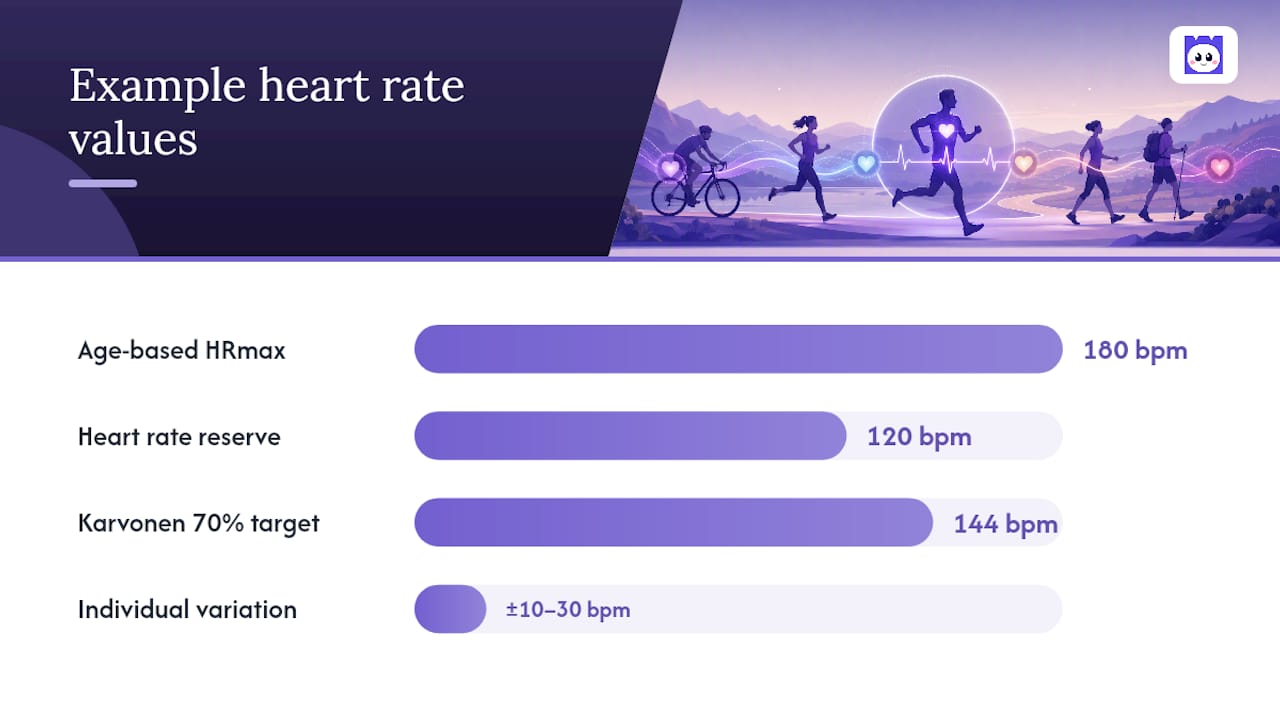
The quickest starting point is the age based formula: 220 minus your age gives an estimated HRmax. For a 40 year old, that is 220 − 40 = 180 bpm. It is a reasonable first estimate, but individual variation means the true figure can sit 10 to 30 beats either side of that number, which matters if you are training close to a threshold.
The Karvonen method, also called heart rate reserve (HRR), is more personalised because it factors in your resting heart rate rather than just your age.
- Find your HRmax (220 minus age, or a tested value).
- Subtract your resting heart rate to get your heart rate reserve. Example: HRmax 180, resting 60, so HRR is 120.
- Multiply HRR by your target intensity percentage, then add back resting heart rate. For 70% intensity: (120 × 0.70) + 60 = 144 bpm.
Pro Tip: Run the Karvonen numbers once with your actual resting heart rate and compare them to the flat age-based percentages. The gap is usually a few beats per minute, but it can be enough to nudge you between zones.
For runners and cyclists chasing a threshold-based plan, a field test offers more precision than either formula. A 30-minute maximal, sustainable effort, with your average heart rate over the final 20 minutes, gives a workable estimate of lactate threshold heart rate (LTHR), according to Runners Connect. The genuine gold standard, though, is a supervised exercise stress test or VO2max assessment in a lab or clinical setting, which measures your true maximum rather than estimating it.
Getting accurate readings: resting heart rate and wearable accuracy

Reliable zones start with a reliable resting heart rate, and the best time to check it is first thing on waking, before you get out of bed or reach for coffee. Harvard Health recommends averaging this over several mornings rather than trusting a single reading, since sleep quality, hydration, and stress all cause day to day swings. For most adults a normal resting rate falls between 60 and 100 bpm, while well trained athletes can sit as low as 40 bpm.
Device choice affects accuracy too. Chest straps read the heart’s electrical signal directly and stay more accurate during high intensity intervals, while wrist based optical sensors can lag or misfire when your arm moves fast or the band sits loosely, a pattern confirmed in comparative accuracy research.
- Wear a chest strap for interval sessions or races where precision matters most.
- Keep a wrist monitor snug and slightly above the wrist bone, and clean the sensor regularly.
- Cross check any single spike or dip against how you actually feel before adjusting your effort.
- Log resting heart rate at the same time each morning for a genuine trend line, not one off numbers.
Applying zones to your training week
The general rule most coaches and clinical sources agree on: the majority of weekly training time should sit in zones 1 and 2, with focused, smaller doses of zone 3 and brief, sharp work in zones 4 and 5. This is not about avoiding hard work. It is about making sure the hard work counts because you arrive at it recovered.
- Zone 2 endurance session: 40 to 75 minutes at a steady, conversational pace. This builds the aerobic engine that everything else depends on, and it should make up the bulk of your weekly volume.
- Zone 3 tempo session: 20 to 30 minutes continuous, or broken into two or three blocks with short recoveries. Sits just below the point where talking becomes difficult.
- Zone 4 to 5 interval session: Short repeats of one to five minutes at hard to maximal effort, with roughly equal or longer recovery between reps, totalling perhaps 15 to 20 minutes of actual work.
A sensible weekly structure for most people is three or four easy zone 1 to 2 sessions, one tempo session, and one interval session, with at least one full rest or active recovery day. Progression should be gradual: add duration or frequency before you add intensity, and treat a week of poor sleep or high life stress as a cue to dial back rather than push through.
Safety limits and when to get medical advice
Certain warning signs mean you should stop exercising immediately and seek medical attention: chest pain or pressure, unusual shortness of breath, dizziness, or a heart rate that feels wildly out of proportion to your effort.
Medication changes the picture too. Beta blockers, commonly prescribed for blood pressure or heart conditions, blunt the heart’s response to exercise, so age based formulas and even Karvonen calculations can be significantly inaccurate for anyone taking them.
- Stop immediately for chest pain, severe breathlessness, or unexplained dizziness.
- Anyone on beta blockers or similar medication should ask a clinician for a personalised target range rather than relying on standard formulas.
- People with existing cardiovascular risk factors should get medical clearance before attempting a maximal heart rate test or starting a high intensity programme.
How Heala helps you put zones into practice
Working out your zones on paper is one thing. Keeping them accurate week after week, across every workout, is another. Heala pulls in heart rate, heart rate variability, sleep, and training data from wearables including Fitbit, WHOOP, Oura, and Apple Health, and centralises it into one view instead of four separate apps.
That matters because your true zones shift as your fitness and resting heart rate change, and a static formula from six months ago quickly goes stale.
- Adaptive daily plans that factor in recent recovery, not just a fixed HRmax estimate.
- One dashboard for heart rate, sleep, and training load instead of switching between apps.
- Trend tracking for resting heart rate, which the guide on why resting heart rate is the cheapest fitness test you own explains in more depth.
If zone 2 training has ever felt suspiciously easy, that is by design, not a flaw, and Heala’s piece on why zone 2 feels too easy is worth a read before you speed up out of habit.
Consistency beats precision
The biggest mistake I see isn’t a bad formula, it’s chasing a single number from a single workout and drawing conclusions from it. One noisy heart rate reading during a windy run tells you almost nothing. A month of readings, tracked consistently, tells you a great deal.
Recovery deserves the same respect as the hard session that comes before it, and device error is normal, not a sign your training is failing. Trust the trend, not the spike.
— Kerem
Try Heala for a clearer view of your training zones
Working out your zones by hand is a fine start, but keeping them current as your fitness changes is where most people lose the thread. Heala centralises heart rate, sleep, and recovery data from your existing wearable and turns it into daily plans that adjust as your resting heart rate and training load shift, rather than leaving you to recalculate percentages by hand every few months.

The free tier covers the basics, and Pro unlocks deeper analytics and adaptive training guidance, built on your own data rather than a generic formula. If you have existing heart conditions, are on medication that affects heart rate, or have any cardiovascular risk factors, raise them with a clinician before starting a new high intensity programme; Heala is a tracking and planning tool, not a diagnostic one. Take a look at the Heala app to see how your own data could sharpen your zones.
Sources
The American Heart Association’s target heart rate chart gives age based bpm conversions. Harvard Health’s explainer covers RPE and fuel source nuance. Cleveland Clinic’s overview details zone descriptions and calculation methods. The CDC’s measurement guidance links heart rate tracking to weekly activity targets.
This article is general information, not a substitute for advice from a qualified doctor. Consult a qualified healthcare professional about your own circumstances before acting on anything here.
- Target heart rates | American Heart Association
- Understanding exercise heart rate zones | Harvard Health
- What to know about exercise and heart rate zones | Cleveland Clinic
- How to calculate your lactate threshold | Runners Connect
FAQ
What is a good heart rate range for my age?
It depends on the activity intensity you are targeting, not a single ideal number. Using the age based formula, a 40 year old aiming for moderate to vigorous exercise would target roughly 90 to 153 bpm, while a 60 year old’s equivalent range would sit lower given a lower estimated HRmax.
What are heart rate zones by age?
Zones themselves are percentages of HRmax (roughly 50 to 100%), so the underlying structure does not change with age, but the bpm values attached to each zone do. A 25 year old’s zone 2 sits higher in bpm terms than an older person’s, even though both represent the same relative 60 to 70% effort.
Is 120 bpm zone 2 cardio?
It can be, but only for certain ages and fitness levels, since zone 2 is a percentage range rather than a fixed number. For a 40 year old with an estimated HRmax of 180 bpm, zone 2 spans roughly 108 to 126 bpm, so 120 bpm would sit comfortably inside it; for a younger or older person the same 120 bpm could fall into a different zone entirely.
What is the danger zone for resting heart rate?
A normal resting heart rate for most adults falls between 60 and 100 bpm, with well trained athletes sometimes sitting lower. A resting rate persistently above 100 bpm, or accompanied by dizziness, chest pain, or breathlessness, warrants a conversation with a clinician rather than a wait and see approach.
Recommended
Heala opens 1 October 2026
Free forever — Pro is optional.
Photo food logging, adaptive training, a morning recovery score and a 3D body twin, in one app.